Quality perspective: Why I spec specialized Vaisala temp and humidity sensors and data loggers
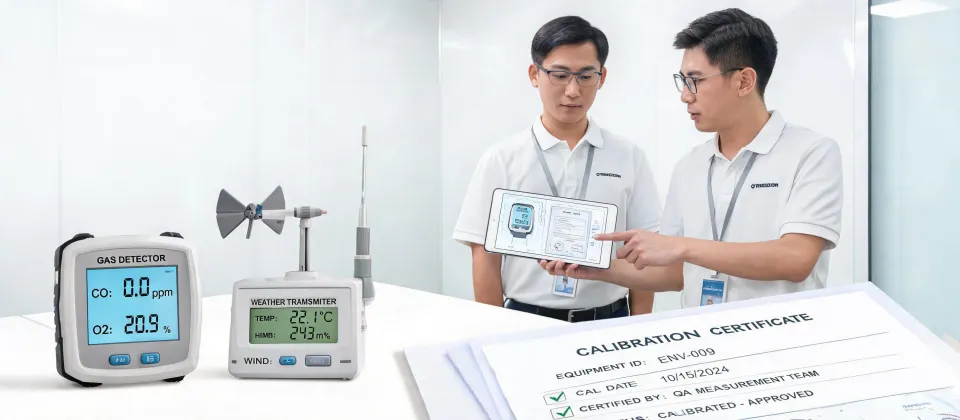
I work as a quality and brand compliance manager for environmental monitoring equipment. Most of my week is spent reviewing specs, checking calibration documentation, and comparing what a vendor promises against what the instrument actually does. In 2024 alone, I rejected roughly 4% of first deliveries because the documentation didn't support the claimed specifications.
So let me state my position clearly: when environmental measurements matter, I don't want a multipurpose instrument. I want a sensor designed for the specific measurement, from a specialist who understands its limits.
The multipurpose trap
Multipurpose instruments look efficient on paper. One handheld device that measures temperature, humidity, air velocity, and pressure sounds like a great way to reduce equipment costs. In practice, though, I've seen too many audit findings caused by a single multifunction device that was "close enough" for one measurement but not actually qualified for the other.
Quality work runs on specifications, not promises. If you need to know whether a storage area meets 20°C ± 2°C and 45% RH ± 10% RH, a rugged general-purpose meter may get you in the ballpark. But in a regulated environment, ballpark readings create investigation headaches. When you choose a dedicated temperature or humidity sensor from a manufacturer like Vaisala, you are usually getting tighter measurement uncertainty and much better long-term stability data.
What I look for in a Vaisala temp and humidity sensor
When someone asks me to recommend a Vaisala temp and humidity sensor, I start with the application, not the product family. For a pharmaceutical stability room or a lithium-ion battery dry room, the Vaisala humidity and temperature transmitter range is usually the right conversation. These sensors are designed for continuous, accurate humidity measurement, not just intermittent spot checks.
The same applies to a Vaisala moisture meter. A moisture meter is only useful if its calibration traceability matches your quality risk. Vaisala's humidity instruments typically come with clear specifications for accuracy across the operating range, which makes it easier to incorporate measurement uncertainty into a risk assessment. That matters more than a slick display or wireless connectivity.
That said, no sensor is perfect everywhere. I've seen well-intentioned teams install a high-end Vaisala temperature and humidity sensor in a location where it gets direct sunlight or sits right next to a supply air vent. The sensor was fine. The placement was wrong. A specialist sensor cannot fix a poorly designed monitoring plan. That is where the quality inspector's job really starts.
Data loggers are only as good as their calibration files
I also review a lot of data loggers. Many people treat a data logger as a simple storage device: you put it in the room, it records values, and later you download the data. From a quality perspective, that is backwards.
A data logger is a measurement system. Its internal sensor, its analog-to-digital converter, and its memory all contribute to the final record. If you never verify the internal sensor against a traceable reference, you are just collecting nice-looking numbers that may not mean very much.
During a warehouse audit earlier this year, I found a seven-day temperature record that looked perfectly stable. The data logger had a certificate, but when I checked the actual calibration points, the corrected values showed a 0.6°C offset at the upper end of the range. For that application, the offset did not create a product safety issue. But the team had no idea the offset existed because they never reviewed the calibration data. That is the kind of gap that eventually causes a costly deviation.
My advice: treat your Vaisala data loggers the same way you treat your reference thermometers. Calibrate them on a defined schedule, review the before-and-after values, and keep the uncertainty budget in your monitoring plan.
When a cheaper sensor is acceptable
I don't want this to sound like every monitoring application needs a premium European sensor. That would be an overstatement.
If you are doing a rough survey of an unconditioned warehouse and you just need to know whether conditions are broadly acceptable, a lower-cost temperature and humidity logger may be enough. It gives you relative trends, and it can tell you if a room is drifting far outside normal conditions. What it cannot do is provide the same level of confidence for release decisions or long-term stability studies.
In quality, the important thing is to match the instrument to the risk. I have no problem with a cheaper data logger when the decision is low-stakes and the tolerances are wide. The problem starts when people assume all loggers are equivalent. They are not.
What an Agilent HPLC column question taught me about boundaries
Sometimes the boundary of expertise shows up in a very practical way. During an audit of a temperature-controlled laboratory, I was reviewing a monitoring system built around Vaisala temperature and humidity sensors. The conditions were well within specification, and the data loggers were properly calibrated.
Then the lab supervisor asked me a completely different question: how often should they change their Agilent HPLC column?
That is not an environmental monitoring question. It is a chromatography question. My honest answer was: it depends on your method, your sample matrix, and the performance of the system.
In general, an Agilent HPLC column should be replaced when it no longer meets the separation requirements of the method. The practical signs are often:
- backpressure rising beyond the normal range for the column and mobile phase;
- peak tailing that cannot be fixed by adjusting the method;
- retention time drift that continues after equilibration; or
- a failed system suitability test, such as resolution or theoretical plates.
Some laboratories set a conservative schedule based on injection count, but that only works if the sample matrix is consistent. If you are injecting clean standards, a column may last for thousands of injections. If you are injecting biological samples or highly acidic mobile phases, the useful life may be much shorter.
The right person to answer that question is a chromatography specialist, not an environmental measurement company. I can tell you how to monitor the room where the HPLC sits, but I should not pretend to be the expert on your column chemistry. That boundary is not a weakness. It is actually a sign that the quality system is working.
Why specialization wins in quality systems
Some buyers prefer a single vendor that can supply everything from environmental sensors to laboratory instruments. I understand the appeal: fewer purchase orders, simpler qualification, one phone call for support. But in my experience, broad product portfolios often come with shallow expertise at the edges.
A specialist like Vaisala earns trust by being clear about what its instruments can do. When you buy a Vaisala humidity meter, you are buying decades of focused work on humidity measurement. When you buy an Agilent HPLC column, you are buying chromatography expertise. Both are valuable—but they are not interchangeable.
If a vendor ever tells you they do everything well, ask for the validation data. Then ask for their calibration philosophy. Then ask them to explain the limitations of their own instrument. The ones who can answer honestly are the ones worth keeping.
In quality, the goal is not to eliminate boundaries. The goal is to know where they are. That is how you choose the right sensor, the right data logger, and the right specialist for the job.

Marcus Feld
Marcus Feld is an electrical test and measurement analyst specializing in multimeters, oscilloscopes, clamp meters, insulation testers, spectrum analyzers, and data loggers. He applies IEC 61010-2-030 and IEC 61010-031 concepts while examining measurement category, bandwidth, true-RMS response, input loading, and stated uncertainty. His work helps maintenance engineers and test teams choose safe instruments with performance suited to the signals and environments they actually measure.