The $340 Order Test: Why I Judge Instrument Suppliers by Their Smallest Invoices
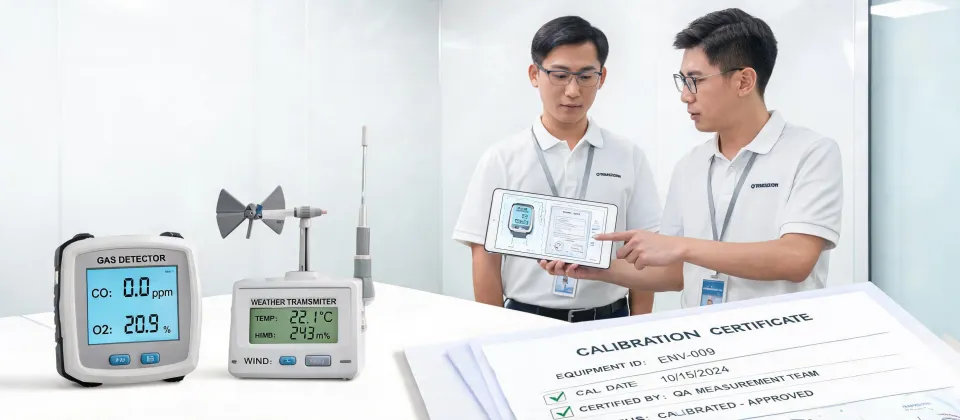
Last quarter I placed a $340 order for two Starrett 799 calipers. The supplier I ordered from treated it like an afterthought — no calibration certificate in the box, no packing slip, no reply when I emailed to ask for one. The vendor I've been using for three years did something different. She emailed me the certificate the same day, apologized for not including a printed copy, and asked whether I wanted calibration stickers for the inspection station.
Same order size. Completely different message about who they'd be if the order were ten times bigger.
Here's my position, and it's the one I'll defend to anyone in procurement: a small order should never get smaller service. If I'm buying a single 8-inch Starrett digital caliper for a backup station, or one oil flow meter for a pilot line, I'm still a customer — and the way a vendor handles a $300 invoice tells me more about their service culture than any big-ticket order ever will.
Context, because it matters: I run purchasing for a 140-person manufacturing shop. I handle roughly $680,000 a year across about 20 vendors — measuring tools, lab equipment, thermal imagers, flow meters, the occasional centrifuge. I report to both operations and finance, and I'm the first person who hears about it when a technician can't find a calibration record at 4:30 on a Friday.
The small order that told me everything
In 2022, I was setting up a backup inspection station. Needed two Starrett 8 inch digital calipers — nothing exotic, just in-stock, reliable, certified. Two quotes came in within $15 of each other. I went with the cheaper one.
What arrived was two calipers in a generic foam box with a photocopied certificate that didn't match the serial numbers. Finance rejected the invoice twice. I ate about four hours of back-and-forth, plus the internal grief of explaining to the quality lead why we couldn't prove the tool's calibration status. Not ideal.
The other vendor — the one I'd used for larger orders — got the same request six months later. Box arrived with matching certs, a calibration sticker, a clear packing list, and a note from the account rep asking if I wanted them added to our annual calibration schedule.
Point being: the small order was the interview. And I finally knew which vendor had passed.
Why the "big orders get better service" logic runs backwards
People assume that big orders are what earn good treatment. Actually, I'd argue it's the reverse. Every vendor rolls out the red carpet for a $30,000 PO — that's not information, that's baseline self-interest. The small order is where the mask slips, and you find out whether the service was ever real or just proportional to the revenue.
The causation runs the other way: the vendors I trust with the big orders are the ones who didn't blink at the small one. Strictly speaking, good treatment didn't produce loyalty — a service culture that shows up on small orders produced both the loyalty and the bigger orders over time.
This isn't a 2005 problem anymore
The "small orders aren't worth our time" mindset is a legacy of an era when filling a two-piece order actually cost more in labor and picking than it earned. That was true maybe 15 years ago when everything ran on paper and warehouses couldn't batch a small pick into a bigger run. Today's well-organized distributor runs a two-piece order and a 200-piece order through the same system with roughly the same per-item handling.
I'm not saying MOQs don't exist for a reason — they do, especially on custom or special-order items. There's a real cost floor. But "our minimum is 10 units" is a different sentence from "we can't be bothered with you." One is a policy, the other is an attitude. Customers read the difference.
Where this really shows up is the awkward middle of purchasing — the accessories and one-offs. The single Flir vs Fluke thermal camera comparison I need to actually run because maintenance can't agree — that's a $1,200 purchase with a lot of pre-sales questions. The oil flow meter I buy once a year. The replacement rotor for the Eppendorf centrifuge 5810 R that nobody planned for. These aren't strategic orders. They're exactly the kind of thing that gets buried in a supplier's inbox when the sales team is chasing bigger accounts. The vendors who don't bury them are the ones I keep.
The pushback, and my answer
I get it — vendors have cost structures, and small orders genuinely are less profitable. I'm not naive about that, and I don't expect anyone to lose money on my $340 order. MOQ policies aren't villainy. Real talk: I don't take my small orders to vendors whose business model rules them out, and I don't hold it against them when they say so upfront. I'm not 100% sure where every distributor draws that line, but the ones I keep seem to have figured out the economics just fine.
But here's the thing. If a vendor has set a price and accepted the order, they've made a promise. Delivering on it — correct certificate, packing slip, an actual reply to my email — isn't charity. It's the bare minimum. Small-friendly doesn't mean free or equal to bulk pricing. It means honoring the terms you agreed to.
What I actually do with this
If you're a fellow admin buyer, my advice is simple: stop treating the small order as a throwaway and start treating it as the test. The vendor who sends your $340 caliper order with the same care as the $30,000 one is the one you consolidate to — every time I've done that consolidation, it's paid off. Small doesn't mean unimportant. It means potential, for both of you.
And if you're on the vendor side reading this: the person placing the small order today is the same person writing the three-year supply agreement tomorrow. Same $340. Same paperwork. Different vendor. That tells me everything I need to know.

Hanae Okamoto
Hanae Okamoto is a process instrumentation analyst specializing in pressure gauges, pressure transmitters, flow meters, level sensors, thermocouples, temperature transmitters, and differential-pressure devices. She applies IEC 61298-2 performance methods and IEC 60751 temperature-sensor characteristics when comparing accuracy, turndown, repeatability, drift, response time, and installed uncertainty. Her work supports instrumentation engineers and plant teams choosing measurement ranges, process connections, calibration intervals, and control-loop interfaces for real operating conditions.