如果你拿到的报价单里没写校准费,那它就不是一份报价单
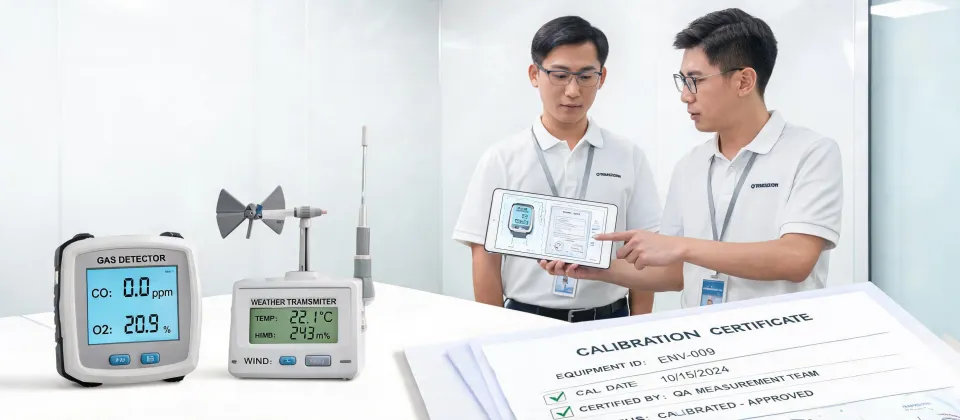
The quoted price is not the price. It is the opening bid.
I've been buying water quality and process instrumentation for a mid-sized environmental testing company for nearly six years. In that time I've spent somewhere around $410,000 on sensors, analyzers, flow meters, and the various consumables that keep them alive. I've negotiated with 20+ vendors and logged every purchase order in a spreadsheet I built myself during my first year (which was a humbling experience).
Here's the thing I've learned the hard way.
The number on the quote is almost never the number you pay. And vendors who are upfront about the full number are, more often than not, the cheaper option in the end.
I know that sounds backwards. It did to me too, once.
What actually happened when I compared two pH meters
Last fall we replaced the benchtop analyzer in our lab. I asked three vendors for a quote on a Hach pH meter — the benchtop unit with automatic temperature compensation, nothing exotic. The quotes came back between $780 and $1,150.
I almost went with the $780 one. Of course I did.
Then I did the thing I always do now, which is strip the quotes down line by line and see what's not in them.
The $780 quote: no electrode replacement included, no buffer solutions, calibration service billed separately at $180 per unit per year. The $1,150 quote: everything in, plus two years of on-site service.
Three-year math, which is our standard TCO window: the "cheap" quote came to $2,140. The "expensive" one came to $1,150. That is a $990 difference, or roughly 46%, hidden in what wasn't written down.
That's not a discount. That's deferred cost.
The DR 3900 example is worse
The Hach DR 3900 spectrophotometer is a bigger purchase, so the same problem shows up with more zeroes. Instrument pricing is actually fairly transparent — you're looking at roughly $5,000 to $8,000 depending on configuration and package (based on publicly listed prices, January 2025; verify current rates). That part is fine. I can budget for that.
What gets under-budgeted is everything downstream. Reagent packs per test. QC standards. And a service contract that runs around $900 per year if you're keeping the instrument calibrated to a traceable standard for compliance work.
Over a three-year instrument life, you can easily spend half the purchase price again on consumables and calibration. No first-page quote I have ever received has said that out loud.
I've learned to ask "what's NOT included" before I ask "what's the price." The second question is easier to answer and less useful.
The flow meter and pressure sensor problem
Same pattern, different equipment.
We needed a Coriolis flow meter for a corrosive-fluid line last spring. The quote for the meter itself was almost identical across three suppliers. The difference was in installation and commissioning — one supplier bundled it, one quoted it separately at a rate that made me blink, and one didn't mention it at all until I asked. Guess which one had the lowest headline number.
And the pressure sensors. Honestly, this one took me an embarrassingly long time. I used to treat the pressure sensor manual as paperwork — something to file after the order arrived. Now I read it before I read the price.
Why? Because the manual tells you whether the unit is factory-calibrated to a traceable standard or whether that's a third-party line item later. It tells you the mounting orientation constraints, which determines whether your install is a two-hour job or a two-day job. It tells you the firmware revision, which determines whether it plays nicely with the rest of your data stack.
The manual is free. The misreading of it is not.
A sideways example: FLIR thermal cameras
Here's the counterintuitive part of my argument, and it's why I think this is about transparency, not about price level.
Every few months someone on my team asks about thermal imaging, and I type "how much is a FLIR thermal camera" into a search bar, and I get an answer in under two minutes. Entry-level handhelds run somewhere in the $500 to $3,000 range; higher-resolution and research-grade units go well above that. I don't have to sit through a discovery call to find out whether it fits a budget line.
That's a vendor publishing its pricing — not low pricing, not discount pricing, just visible pricing. And it saves me an hour every single time.
I've never bought a FLIR camera. But I know exactly what one costs, and I trust the company more for it. That's worth something.
"Public pricing is just a marketing tactic"
I've heard the pushback. Somebody always says: the visible price is a marketing move, the real discounts happen in the negotiation, anybody who publishes a number is just anchoring you.
There's some truth in that. Negotiation exists. Volume discounts exist.
But here's where the argument falls apart: a discount and a hidden fee are not the same thing, and treating them as the same thing is how procurement departments get burned.
A discount is money you didn't have to spend. A hidden fee is money you were always going to spend, disclosed late enough that you'd already committed. One of those is a business decision. The other is a surprise, and surprises in a capital budget are a red flag no matter how good the vendor's product is.
The bottom line: I'd rather over-pay on the quote and under-pay on the invoice.
When I got it wrong
I'll admit this wasn't an overnight conversion.
Back in 2022 I went with the lowest bidder on a bundle of conductivity sensors because the numbers were clean and my budget was tight. The units arrived fine. Then the calibration certificates cost extra. Then the replacement cables weren't standard. Then the first failure took 11 days to resolve because the service agreement I thought was implied (it wasn't) needed to be purchased separately.
I approved that PO on a Friday and spent the weekend second-guessing myself. What if the sensors drifted out of spec before we caught it? The whole week until the first calibration run was stressful (ugh, and expensive).
I built the TCO calculator the following quarter. Every order since then goes through it — quote total, calibration cost per year, consumables per year, service contract, and a line item called "stuff I had to ask about." That last line is usually the biggest one.
There's something genuinely satisfying about handing a vendor a quote that's been stripped down and rebuilt with all the real numbers on the table. After the years of invoice archaeology, finally getting a clean, complete picture — that's the payoff.
So here's my position, again
Transparent pricing beats cheap pricing. Not because transparency is a virtue in itself, but because a vendor who shows you the whole number is a vendor you can plan around, and planning around a vendor is worth more than saving 15% on a purchase order.
You might be wondering whether this rule holds for smaller purchases — a single electrode, a replacement cable, a box of standards. Honestly? It doesn't apply as cleanly. For a $200 order, the hidden-cost risk is small and the time you spend on TCO analysis is worth more than the money you'd save.
But for anything over roughly $1,000, or anything with a service contract attached, or anything whose consumables have part numbers? Ask the awkward question first. What's not included. How much is calibration. Who pays for the install.
The vendor who answers all of that without flinching is the one you want. Even if their first number is higher.
Pricing references in this article reflect publicly listed figures as of January 2025 and are provided for general reference only. Actual prices vary by vendor, configuration, location, and order timing. Verify current rates before budgeting.

Noura El-Sayed
Noura El-Sayed is an analytical and laboratory instrumentation analyst specializing in HPLC systems and columns, spectrophotometers, pH meters, pipettes, centrifuges, viscometers, and sample filters. She applies ISO 8655 liquid-handling methods and USP <621> chromatography principles while evaluating delivered volume, precision, flow accuracy, resolution, carryover, and detection limits. Her work helps laboratory managers and method developers select instruments, qualify workflows, and control sources of variability from sample preparation through analysis.