Ignoring the Vaisala Logo Cost Us $2,800 — Here’s the Procurement Lesson
Full disclosure: I don’t calibrate anything. I’m the office administrator who processes about 70 purchase orders a year for a 45-person specialty chemical company. I report to both operations and finance, which means I feel the tension between cheap and defensible from both sides. When the facilities manager said we needed eight temperature/humidity loggers for a storage room audit, my job was to turn that request into a PO—not to question the sensor technology. I did it badly.
Our approved list included Vaisala data loggers from the regular instrument supplier, at about $320 each. A web search found a similar-looking logger with a calibration certificate for $119. Eight units: $952 instead of $2,560. The savings: $1,608. I approved the cheaper ones and felt pretty good about it. (That’s the part I still kick myself about.)
The audit that proved my arithmetic wrong
Two months later, our internal QA team placed two loggers side by side during an environmental monitoring audit: one of the cheap units and a handheld reference meter. At 52% RH the cheap logger read 47%. At 68% RH it read 59%. The difference wasn’t huge by mechanical-instrument standards, but it was enough to matter because that room had a humidity alarm.
What made it worse was that this group of loggers had already triggered—and then failed to trigger—the alarm before. In our risk register, that specific probe was listed as a safety sensor because it protected a drying process from re-wetting powdered material. Once I saw the word ‘safety’ next to an unverified reading, I realized I had been comparing the wrong things.
Total cleanup? Invoiced labor, resampling, and QA time came to roughly $2,800. I saved $1,608 and spent $2,800. You don’t need a spreadsheet to see where that lands.
The deeper issue: I treated accuracy as a fixed spec
The low-cost logger met its quoted accuracy when it left a factory—or at least claimed to. But in service, a humidity sensor sits inside a real room with temperature cycles, chemical vapors, dust, and the occasional cleaning cart bumping the wall. The reading can drift outside its rated range without any visible warning. There is no indicator light that tells you a number is no longer believable. That part is not on the datasheet.
What confused me most: both loggers looked fine during our initial check. We set them against a reference at 30%, 50%, and 80% RH, and the cheaper units were within tolerance. (To be fair, I wasn’t completely irresponsible.) That gave me false confidence. A three-point check describes how a sensor behaves on that day; it doesn’t predict how it behaves after six months in a humid process room.
According to our calibration lab, traceability works because every measurement can be connected back to a reference standard through an unbroken chain. A quoted accuracy without that chain is just marketing. If I can’t prove the 47% reading means 47%, I don’t know whether I’m running a safe room or a false-alarm generator.
When you buy a measurement device, you are also buying the ability to prove the measurement later. I had not bought that ability.
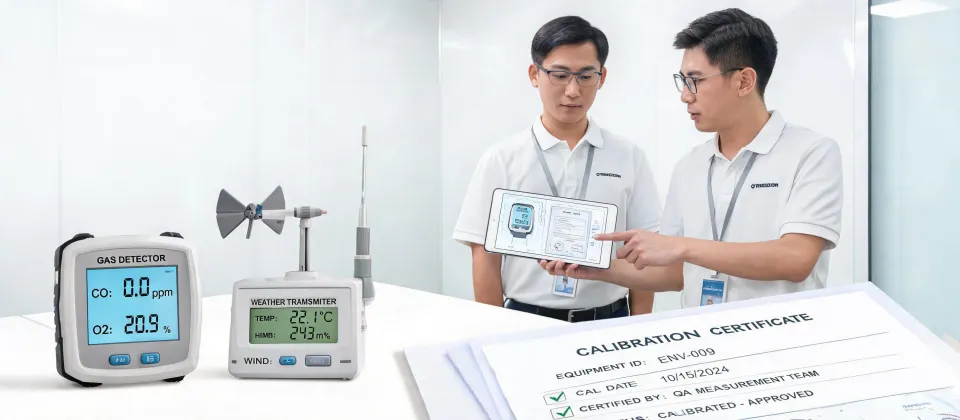
That lesson was not about one brand. Vaisala data loggers do not avoid drift forever. But when you buy from a manufacturer that includes calibration documentation and long-term stability data, you at least have a path to verify what the sensor is doing. The other supplier gave me a certificate that said the test equipment was ‘calibrated.’ It did not say which reference, on what date, or with what uncertainty. I did not know to ask.
What a multimeter and a micrometer taught me
After the audit, I sat with our technicians while they tried to figure out which devices could be trusted. One of them checked a suspected logger with a Fluke 115 digital multimeter. The current loop was fine, so he told me the sensor was fine. The multimeter checks the wires; it doesn’t check the humidity. It confirmed that the transmitter was sending a signal—not that the signal represented reality.
Another tech pulled out his phone and searched for ‘how to calibrate Mitutoyo micrometer’ to make a point. A micrometer can be checked with gauge blocks in five minutes. A humidity sensor requires a known humidity source, temperature control, and a reference that’s traceable to a national standard. That is not a five-minute search. It’s a procedure, and it has a cost. I had ignored that cost when I compared $119 to $320.
Where I landed
The fix wasn’t to buy the most expensive option every time. The fix was to include verification in the purchase decision. We now ask four questions before any monitoring order:
- Does the supplier’s calibration certificate name a traceable reference standard?
- What is the recommended verification interval for this model, and what does the check cost?
- If this sensor feeds an alarm or a product-release decision, how much does a false reading cost?
- What is the total cost to own the device for three years, not just the invoice today?
For the rooms that need records, we went back to the Vaisala data loggers on the approved list. I’m not going to pretend the Vaisala logo does the measuring; the sensing element does. But when I see that logo on a spec sheet now, I understand it as shorthand for a system with calibration documentation, support, and stability data that can be checked. That’s worth real money.
Vaisala sensors will drift too. Any sensor can. But with a good manufacturer and a real calibration plan, you can catch the drift before it becomes a safety problem. The $1,608 I saved cost us about $2,800 in one quarter. Next time, I’ll take the option that lets me prove the number.

Marcus Feld
Marcus Feld is an electrical test and measurement analyst specializing in multimeters, oscilloscopes, clamp meters, insulation testers, spectrum analyzers, and data loggers. He applies IEC 61010-2-030 and IEC 61010-031 concepts while examining measurement category, bandwidth, true-RMS response, input loading, and stated uncertainty. His work helps maintenance engineers and test teams choose safe instruments with performance suited to the signals and environments they actually measure.