Vaisala vs. Budget Sensors: What the Price Tag Doesn't Tell You
The Comparison Nobody Gave Me
When I took over instrument procurement for a 200-person industrial monitoring company in 2019, I had one question: is the Vaisala premium actually worth it?
Back then I managed roughly $180,000 in annual spend across measurement equipment—not just sensors, but laser micrometers, lab microscopes, a Rice Lake weighing system, the works. Most vendors fell into two camps: specialized European brands with high price tags, and local distributors offering "good enough" gear at half the cost. Vaisala sat firmly in the first camp.
The question isn't "which sensor is more accurate?" That's too simple. The real question is: which one costs less over five years, for the specific application you're running? Here's how I answered it after six years of tracking every invoice, calibration event, and unplanned failure.
Dimension 1: Upfront Price vs. Total Cost of Ownership
Let's get the obvious thing out of the way. A Vaisala temperature sensor—say, an HMP series transmitter—costs somewhere between $600 and $900 depending on configuration. A no-name equivalent can be had for $150 to $300. On a 20-unit rollout, that's a $10,000+ gap at the moment of purchase. Anyone comparing quotes at that level is going to pause. I did.
But quotes don't capture what happens in year two. From our internal cost tracking system (which I built specifically after a painful budget overrun), here's what we observed across continuous manufacturing use:
- Budget sensors: roughly 30% per year needed replacement. Calibration costs averaged $85 per unit per year.
- Vaisala sensors: roughly 8% per year needed replacement (and most failures were surge-related, not sensor-related). Calibration every two years ran about $125 per event.
Do the math out to five years and the totals are nearly identical: about $1,100 per measurement point for either option. The budget path spreads the pain across frequent replacements. The Vaisala path concentrates it upfront.
We also made the classic penny-wise mistake in 2020: saved about $1,800 by ordering a batch of off-brand sensors for a secondary site, thinking we'd found a loophole. The following year we spent $4,700 on rush replacements, expedited calibration, and a Saturday emergency install when three of them died in the same week. The "savings" evaporated the moment we needed support. (That spreadsheet now lives permanently in my training documents.)
Why does this matter? Because "we spent less" and "we saved money" are not the same sentence. One shows up in the budget report. The other shows up after the audit.
Dimension 2: Accuracy, Drift, and What a Spec Sheet Really Tells You
Here's where things get less obvious.
Vaisala publishes a temperature accuracy of ±0.2°C for many of their probes (at 20°C, per the datasheet I've been referencing since 2019). The budget vendor claimed ±0.3°C. On paper, the difference looks negligible.
In our independent checks against a NIST-traceable reference, the Vaisala units held spec for more than 18 months in continuous service. The budget units? Some held spec for six months. Others drifted to two or three times their stated accuracy within a year. The manufacturer's spec wasn't wrong—it was just optimistic about real-world conditions.
This is where I made my rookie mistake. In my first year of procurement, I assumed "standard accuracy" meant the same thing to every vendor. It doesn't. A spec is only meaningful if the device stays inside it for a useful portion of its life. Cheap sensors measure drift in weeks, not years. That lesson cost us a $600 re-verification cycle that I still think about whenever someone says "but the spec is basically the same."
The WXT536: An Exception Worth Understanding
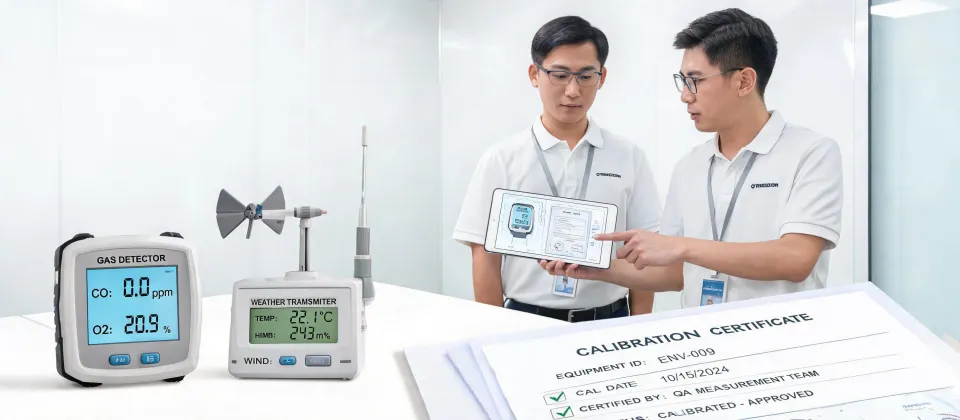
For outdoor weather work, the comparison changes entirely. Consider the Vaisala WXT536 weather transmitter specifications, because this unit does something budget single-sensors can't: it bundles wind speed and direction, precipitation, barometric pressure, temperature, and humidity into one enclosure. Specs from memory: wind speed up to 60 m/s, wind direction 0–360°, pressure 600–1100 hPa, temperature approximately –52 to +60 °C, humidity 0–100 %RH, all over RS-485 or SDI-12. I'm not 100% sure of every current value, so verify against the latest datasheet when you budget.
Now, the honest comparison: you could build a "budget weather station" from individual components—a cheap anemometer, a rain gauge, a separate temp/RH probe, a pressure transducer. But then you're mounting four devices, maintaining four calibration schedules, and dealing with the fact that each sensor sits at a slightly different height and orientation. In my experience, the multi-vendor route comes out 30–40% more expensive than the WXT536 once installation, integration, and data alignment are included. That's the hidden cost that doesn't appear on any quote.
Ironically, the disciplines are transferable across instrument types. If you've ever had to learn how to read a Rice Lake weighing systems calibration sheet—tolerance classes, as-found vs. as-left readings, which weights were used—you already know most of what you need to evaluate a sensor calibration report. The vocabulary is the same: uncertainty, traceability, stability over time.
Dimension 3: Calibration, Documentation, and the Fine Print of Trust
Documentation quality is a dimension that doesn't show up in price comparison tables—until it does.
Vaisala's calibration certificates include measurement uncertainty, traceability to national standards, and as-found/as-left data. That's genuinely useful for quality audits, especially in regulated industries. The budget vendors we tried? Some sent a one-page "passed" stamp with no uncertainty statement. That's not calibration documentation; that's a receipt with confidence.
But Vaisala has its own friction points. Calibration turnaround in our region has ranged from three to six weeks, depending on the season. That's a serious operational cost if you run a single-sensor-critical process. We now keep redundant modules for critical points, which adds inventory cost. Budget sensors, by contrast, are usually replaced rather than recalibrated—faster, but recurring.
I follow measurement-industry news fairly closely. Microscope news isn't directly in my lane, but the calibration and drift discussions in that niche translate well to what we do. Weighing systems too—the vocabulary of uncertainty and traceability is universal. I've learned more from adjacent fields than from sensor marketing materials, honestly.
One caveat: be suspicious of the phrase "calibrated to NIST." Just because the reference lab is accredited doesn't mean the sensor will hold that tolerance until next year's recalibration. Our real-world experience is that environmental stress (thermal cycling, condensation, voltage transients) determines drift more than the initial spec does. That's why we validate installed Vaisala transmitters against a portable reference every six months for critical points. It's extra work. It's also, unfortunately, necessary.
When Vaisala Makes Sense—and When It Doesn't
After six years, my rule of thumb is less "premium vs. budget" and more "critical tolerance vs. tolerable tolerance."
Choose Vaisala when:
- The measurement drives a process decision (cleanroom release, pharmaceutical storage, safety interlocks)
- You need consolidated outdoor weather data in one reliable package (the WXT536 genuinely earns its keep here)
- You can't absorb the operational cost of frequent sensor swaps
- Your quality system requires strong traceability documentation
Choose the budget option when:
- Your tolerance band is wide (±1.5°C or more) and silent drift won't harm anything
- The installation is temporary (under two years)
- You have in-house calibration capability and can absorb higher replacement rates
- The failure mode is immediately visible and doesn't require backup instrumentation
That last scenario is not hypothetical. We currently run budget sensors in a few non-critical warehouse zones. They work fine, because the process allows for drift and we replace them proactively. I'd rather buy a specialized instrument from a specialist who tells me when I don't need it than from a generalist who says "we can do everything." There's a weird trust that comes from a vendor saying "this isn't the right tool for that job"—it makes me believe them more when they say it is the right tool for the next one.
This assessment was accurate as of the first quarter of 2025. Sensor pricing, datasheet values, and calibration lead times all shift over time. Verify current specifications and quotes before you commit. Things may have evolved since I last opened a quote.

Marcus Feld
Marcus Feld is an electrical test and measurement analyst specializing in multimeters, oscilloscopes, clamp meters, insulation testers, spectrum analyzers, and data loggers. He applies IEC 61010-2-030 and IEC 61010-031 concepts while examining measurement category, bandwidth, true-RMS response, input loading, and stated uncertainty. His work helps maintenance engineers and test teams choose safe instruments with performance suited to the signals and environments they actually measure.