Vaisala Sensors vs. Budget Alternatives: What Six Years of Orders Taught Me
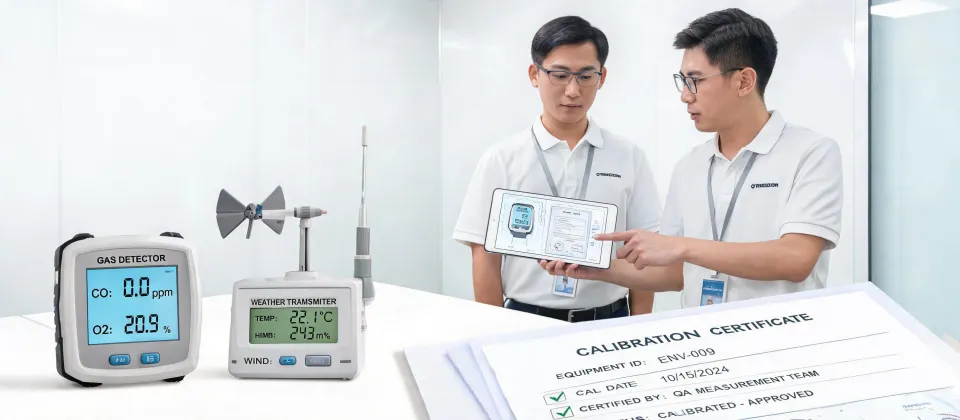
People often ask me whether Vaisala sensors are worth the premium over cheaper alternatives. Six years ago, I would have answered with a simple yes and moved on. Now that I've processed purchase orders for measuring instruments, watched calibration results come back, and explained more than one sensor failure to a frustrated customer, my answer is more detailed. The real comparison isn't just about price. It's about field accuracy, long-term stability, calibration documentation, and how the vendor treats you when your order is small.
The comparison that actually matters
I used to compare sensors on a spreadsheet: accuracy, range, response time, price. Then I realized the spreadsheet was misleading me. A sensor that performs well in a controlled calibration chamber can act differently in a dusty warehouse, a humid cleanroom, or a lab with cycling air conditioning.
So now I compare four things instead:
- Published accuracy vs. field accuracy – what happens when the environment isn't a calm, steady reference condition.
- Long-term stability – how much a sensor drifts between calibrations, not just how accurate it is on day one.
- Calibration paperwork – whether you can actually prove the reading later in an audit.
- Total cost per good reading – including support, downtime, failed inspections, and how a supplier handles a one-piece order.
The conclusion isn't that Vaisala is always worth the money. The conclusion is that all four dimensions change the math.
Dimension 1: Datasheet accuracy vs. field accuracy
In my first full year (2017), I approved an order for six lower-cost relative-humidity transmitters for a sample storage area. The datasheets looked close enough to the Vaisala quote. They arrived with certificates, and I felt smart about the savings. No wait—they arrived with pieces of paper that looked like certificates.
Two weeks later, the night shift called. Our reference hygrometer read about 70 %RH. The new units were scattered between 62 and 73 %RH, depending on where they were mounted and how fast the room was swinging. I had checked one unit against the reference, assumed the other five were fine, and skipped proper verification. That mistake cost us roughly $1,200 in extra mapping work plus a week of distrust in the monitoring data.
That experience defined what I call field accuracy. A Vaisala sensor isn't magic, but its calibration is usually validated over a much wider set of conditions. In a stable, clean, temperature-controlled environment, a lower-cost sensor can perform perfectly well. In a process with fast humidity changes, chemical vapors, condensation, or high temperatures, the difference between %RH readings becomes a real business problem.
One lab I worked with had an HPLC 1100 method that kept misbehaving in the afternoon. Their room sensor showed nice, stable humidity, so nobody suspected the environment. We put a logging Vaisala probe in the same space for a day. The humidity was swinging by nearly 12 %RH every afternoon when the air conditioning cycled. The old sensor was not reporting reality; it was just too slow to show the swings.
The conclusion: field accuracy wins. If a sensor can't track reality, the last decimal place on the datasheet is irrelevant.
Dimension 2: Drift and long-term stability
Humidity and moisture sensors drift because they are exposed to the thing they measure. Dust, solvents, high humidity, and temperature cycling slowly change the sensing element. That's true for every manufacturer, including Vaisala. But the rate of drift is not the same.
When someone asks for a Vaisala moisture meter, I first ask what they actually need to measure. Moisture can mean relative humidity in air, dew point in compressed gas, water activity in a powder, or trace moisture in oil. Each application stresses the sensor differently. That distinction matters more than which brand sticker is on the housing.
Drift is why I stopped selecting instruments solely by initial accuracy. A lower-cost capacitive humidity sensor can be within tolerance when it's calibrated and still drift by several %RH after a few months in warm, humid conditions. In my experience, Vaisala sensors drift less in most industrial applications, but they still need regular calibration. Nothing in this industry is maintenance-free.
In September 2022, we pulled twelve installed instruments for annual recalibration. The number that failed stands out in my memory: around a third of the lower-cost units exceeded tolerance. Maybe it was four out of twelve, I'd have to check the report. The Vaisala units all came back within spec. That one calibration event changed how I write recommendations.
The conclusion: if the measurement point is hard to access, or if the data will be used for a release decision, buy stability. If the sensor is temporary and easy to replace, a budget option may be acceptable.
Dimension 3: Calibration paperwork and the part nobody reads
The most frustrating part of instrument work isn't the sensor itself. It's the documentation. A good measurement is useless if you can't prove what it was, when it was measured, and how far off it could be.
Weighing scales are not my main specialty, but I had to learn that lesson with a Rice Lake system. I once ignored a calibration sheet because the instrument was a scale, not a moisture probe. That was a $320 mistake. Actually, $640 after we had to ship the scale back for a second calibration and pay for expedited turnaround.
How to read a Rice Lake weighing systems calibration sheet
If a Rice Lake calibration sheet is in front of you, don't just look for the PASS stamp. Check four things:
- Instrument identification: confirm the model, serial number, capacity, and division size match the actual scale.
- Applied load and display readings: look for readings at multiple test points and at increasing and decreasing loads.
- As-found vs. as-left columns: as-found shows the condition before adjustment. As-left shows the condition after adjustment. If only one set of numbers exists, ask why.
- Standard traceability: the test weights must have their own certificate and be traceable to a national or accredited reference.
The same logic applies to Vaisala calibration certificates. Check the model and serial number, the calibration date, the reference instrument used, the uncertainty, and whether the sensor was adjusted. If a sheet says calibrated but doesn't say against what standard or by which lab, it's decorative.
A calibration sheet is just a memory. If you don't read it, you don't know what your instrument has been through.
The conclusion: documentation can matter more than the sensor itself. A high-end instrument without readable traceability has no advantage over a cheaper one with a clear, accredited certificate.
Dimension 4: Total cost and small orders
Let's be honest: Vaisala sensors often cost more upfront. Sometimes quite a lot more. But my job requires looking at what happens after the purchase order.
The real cost of a cheap sensor includes extra verification checks, unplanned replacements, failed audits, and process downtime. In 2023, I want to say we spent around $4,000 recovering from sensor-related documentation problems. Maybe it was $3,600, but don't quote me on the exact figure. The point is that the cost did not appear on the original quote.
Here's the part that doesn't get discussed enough: small orders. I place small orders all the time, and a single Vaisala moisture meter probe is a normal order for us. Good suppliers treat that the same way they treat a large order. They answer technical questions, provide a real certificate, and respect the lead time.
Some suppliers assume a small order isn't worth their time. If they do that before the sale, they will almost certainly do it after the sale when something goes wrong. That's not a brand issue. It's a service issue. I've learned not to give my small orders to people who make me feel guilty about my budget. Today's small company can be next year's repeat customer, and the vendor who ignores that is making a larger mistake than saving a few dollars on a sensor.
The conclusion: compare the total cost per reliable reading, and pay attention to how a vendor treats a one-item order. Small doesn't mean unimportant; it means the buyer is still deciding whether to trust you.
So what should you actually choose?
I no longer give one-size-fits-all answers. My advice depends on the situation:
- Choose Vaisala sensors for controlled environments, critical process monitoring, audit-ready data, difficult-to-access installations, or applications where 1% RH makes a real difference to product quality.
- Choose a lower-cost option for temporary field surveys, teaching setups, benchtop experiments, or any application where a failure simply means repeating the test at minimal cost.
If you're a small lab with a tight budget, I would rather sell you one Vaisala moisture meter with a clear calibration certificate than two cheaper devices with vague histories. The small order isn't the problem. Unreliable data is.
This is based on what I've observed through early 2025. Product lines, firmware, and calibration policies change, so verify current specifications before ordering. And if a supplier treats your small order like a burden, let that be your first clue.

Marcus Feld
Marcus Feld is an electrical test and measurement analyst specializing in multimeters, oscilloscopes, clamp meters, insulation testers, spectrum analyzers, and data loggers. He applies IEC 61010-2-030 and IEC 61010-031 concepts while examining measurement category, bandwidth, true-RMS response, input loading, and stated uncertainty. His work helps maintenance engineers and test teams choose safe instruments with performance suited to the signals and environments they actually measure.