Vaisala Buying FAQ: Moisture Meters, Humidity Transmitters, and Sensor Brand Questions
-
Is Vaisala a good brand for sensors?
-
What should I check before buying a Vaisala moisture meter?
-
What's the difference between a Vaisala humidity and temperature transmitter and a cheap sensor?
-
What about a Vantage laser tracker? Is that a Vaisala product?
-
And the 1507 insulation tester? Is that Vaisala?
-
Is Balluff a good brand for sensors?
-
Should I pay extra for a Vaisala calibration certificate?
-
What's the most common Vaisala buying mistake you still see?
I handle sensor procurement for an environmental monitoring contractor. I've personally made—and documented—14 significant buying mistakes over the last six years, totaling roughly $18,000 in wasted budget. Now I maintain our team's ordering checklist, so I get asked the same questions over and over. This is my honest FAQ for anyone buying Vaisala equipment or trying to sort out sensor brands.
My experience is based on about 120 environmental sensor orders, mostly in the $300 to $2,500 range. If you're buying a complete weather station network or a single lab probe, your experience might differ. But the questions below are the ones that actually come up.
Is Vaisala a good brand for sensors?
Short answer: yes, for environmental and weather sensing. Vaisala is a Finnish company that has been at it since 1936. Their core lane is humidity, temperature, dew point, carbon dioxide, barometric pressure, and weather instrumentation. Their HUMICAP sensor technology is well known in industrial and meteorological applications because long-term stability matters when you're monitoring something for years, not days.
But I'd argue the brand name is not the main risk. The main risk is configuration. I've watched procurement teams pay Vaisala prices and still order the wrong probe, wrong cable, or wrong output. The sensor was great. The order was wrong. That's not a knock on Vaisala, but it's a real cost.
What should I check before buying a Vaisala moisture meter?
First, make sure a Vaisala moisture meter is actually what you need. Vaisala doesn't make the pin-type moisture meters used on wood or drywall. Their moisture instruments are process devices for compressed air, natural gas, oil, and similar applications. If that's the right category, then check these five things before ordering:
- Measurement range and accuracy
- Maximum pressure and temperature rating
- Process connection and thread size
- Insertion depth or sampling chamber
- Output signal and power supply
In 2019, I ordered six process moisture meters for a compressed air skid and assumed the standard probe would fit the existing fittings. It didn't. The threads were different. $1,400 in adapter parts plus a week of downtime, because I didn't verify the mechanical connection before ordering.
What's the difference between a Vaisala humidity and temperature transmitter and a cheap sensor?
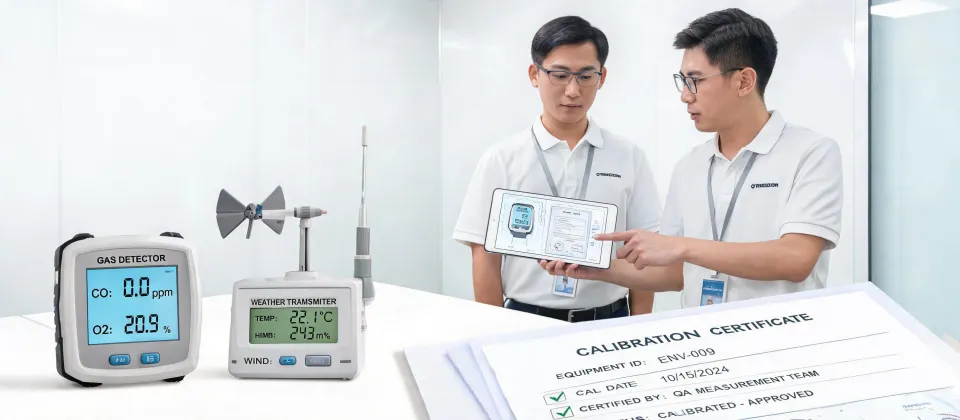
Honestly? A lot, but maybe not in the way you'd expect. A cheap transmitter can meet the same accuracy spec on paper. The difference shows up after six months or a year. Vaisala's HUMICAP sensors are designed for low drift over time. If you're controlling an office HVAC system, a lower-cost probe is probably fine. If you're validating a pharmaceutical storage room, you want the stability and the documentation.
Everything I'd read said, buy the cheapest sensor that meets your accuracy spec. In practice, I found the opposite for our use case. The cheap units drifted, and recalibration cost ate the savings. Now I look at total cost: initial price, expected drift, calibration interval, and the cost of a failed audit.
According to Vaisala's product documentation, their humidity transmitters use HUMICAP sensor technology designed for long-term stability. That's part of why a Vaisala humidity and temperature transmitter costs more than a basic duct sensor. But the extra cost only makes sense if long-term stability is actually important for your process.
What about a Vantage laser tracker? Is that a Vaisala product?
No. I get this one more than you'd think. A Vantage laser tracker is from the metrology world—that's coordinate measurement for precision alignment, not environmental monitoring. If a spec sheet says Vaisala moisture meter and Vantage laser tracker in the same section, you're probably looking at two completely different instrument categories.
In September 2022, a project spec mentioned laser tracker and I assumed it was some kind of weather-tracking sensor. It was not. It was for aligning equipment in a factory. That error cost us about $900 in expedited shipping and a few very awkward conversations. Now I read every spec line twice and ask the engineer to confirm the instrument category before I touch a purchase order.
So: if you need a Vantage laser tracker, Vaisala is not your supplier. If you need a weather transmitter, that's Vaisala's world. Different tools, different catalogs.
And the 1507 insulation tester? Is that Vaisala?
Another no. The 1507 insulation tester is commonly used to check motor windings, cables, and electrical installations. According to Fluke's product page, the 1507 is their insulation resistance tester. Vaisala doesn't make insulation testers as far as I know.
I'm not 100% sure about every model they've ever produced, but I've never seen one on their site. So if someone quotes a 1507 insulation tester as a Vaisala item, double-check the part number and the supplier. Mixing voltage-testing gear with environmental-testing gear can get you the wrong tool and, worse, a wrong acceptance on your validation paperwork.
Is Balluff a good brand for sensors?
Fair question, and I have to be honest about my limits. Balluff is well known in industrial automation for photoelectric sensors, inductive proximity sensors, RFID, and similar factory-floor components. I've seen their name on plenty of automated lines, and they have a solid reputation in that world.
But I don't have hard data on Balluff's long-term reliability across every product line. My experience is mostly environmental sensors, so I can't honestly compare Balluff's humidity sensing to Vaisala's—because I haven't used Balluff for that. Take this with a grain of salt. If you're choosing a sensor brand, the right question isn't is Brand X good? It's is Brand X the right specialist for your measurement? A great photoelectric sensor brand can still be the wrong choice for dew point.
That's the professional with boundaries thing. A vendor who says this isn't our strength—here's who does it better earns my trust. I'd rather work with a specialist who knows their limits than a generalist who overpromises.
Should I pay extra for a Vaisala calibration certificate?
In my world, yes, if someone else will audit the measurement. The certificate gives you a baseline before the sensor goes into service. Without it, you're trusting the factory default and hoping the stored values are close enough.
I wish I had tracked how many audit findings were caused by missing certificates. What I can say anecdotally is that every customer who asked for the certificate had a smoother acceptance than the ones who didn't. That's not scientific, but it's enough for me.
Just remember: a calibration certificate is a snapshot. The sensor will still drift, and it still needs periodic calibration. Vaisala transmitters are built for long-term stability, not immortality.
What's the most common Vaisala buying mistake you still see?
Ordering the model number from memory instead of the current datasheet. I did it in 2020. I knew I should pull up the latest product page, but thought, we've bought these before. The Vaisala transmitters arrived with a different probe type because the manufacturer had updated the ordering code and the old code was no longer valid. $3,200 order, a 10-day delay, and a very quiet team meeting.
My rule now: for any sensor order over $500, I require the exact part number, a screenshot of the current datasheet, and a second set of eyes. That simple check has caught 47 potential errors in the last 18 months. In my experience, 90% of Vaisala buying mistakes aren't about the brand or the price. They're about missing configuration details.
Marcus Feld
Marcus Feld is an electrical test and measurement analyst specializing in multimeters, oscilloscopes, clamp meters, insulation testers, spectrum analyzers, and data loggers. He applies IEC 61010-2-030 and IEC 61010-031 concepts while examining measurement category, bandwidth, true-RMS response, input loading, and stated uncertainty. His work helps maintenance engineers and test teams choose safe instruments with performance suited to the signals and environments they actually measure.