Small Orders, Big Gaps: The $4,800 Vaisala HUMICAP Sensor Lesson
I'm the office administrator for a 120-person industrial services company. I manage purchasing for maintenance, facilities, and the R&D lab—roughly $80,000 a year in mostly small and medium orders. I report to operations and finance, so I see the same mistake twice: once on the invoice and once when a manager asks why the replacement wasn't right.
This article is about the $4,800 lesson I learned from a $320 Vaisala HUMICAP sensor. The sensor wasn't the real problem. The buying process around it was.
What Looked Like a Vaisala Sensor Failure
Eight months after we installed a replacement transmitter in a QC cleanroom, the maintenance supervisor sent me a photo. The wall unit was reading 61.8 %RH; his handheld reference read 55.0 %RH. For a room held at 55% RH, that is a big enough difference to stop work and start an investigation.
My first instinct was the usual one: we had a bad Vaisala HUMICAP sensor. Vaisala is not a brand that fails without a reason. But when a unit drifts that much that quickly, everyone blames the component. I did too.
Then I looked at how that unit was bought. It had been ordered from a national distributor as an urgent small spare-part order. There was no calibration certificate in the box, no serial number cross-check, and no acceptance test before installation. We didn't have a receiving process for sensor products. Honestly, I did not know we needed one.
The Deeper Problem: Small Orders Don't Get the Same Engineering Support
Here is the part that took me a while to understand. When the order value is small, the invisible support that sits around the product disappears. For a big order, someone at the distributor validates the part number and asks questions. For a mid-size order, a customer service rep might ask about measurement range. For a $320 replacement sensor, you are lucky if the website asks you to enter the complete model code.
Vaisala products are configurable instruments, not commodities. A Vaisala CO2 sensor has to be selected for the right range, power, voltage, and communication output. A Vaisala HUMICAP sensor usually has to match the exact transmitter or probe version. If you buy without the full Vaisala product code, you are rolling the dice.
I see the same pattern in the non-Vaisala items I buy. When I needed a rotary encoder last year, the quote had the right shaft size but the wrong electrical output. A trained applications engineer would have caught it. Nobody on the catalog side was paid to think about a one-line item. In the R&D lab, a pipette pen can have several volume ranges and tip styles; the brand was never the issue. The issue was that nobody on the order path asked what we were actually measuring.
That experience changed my view. Small orders don't have to get worse service. But they often do, because the supporting process treats them like commodities. The buyer has to build the quality gate that the supplier doesn't provide.
When 'New in Box' Is Not Enough
One of our facilities techs looked up how to use Extech moisture meter after a wall appeared damp but the readings looked flat. It turned out the meter was not the problem—he had ignored the material setting on the display. A more expensive meter would not have helped. The same lesson applies to a Vaisala CO2 sensor or a rotary encoder: if the technical context is missing, the product can fail in practice even while it works on a bench.
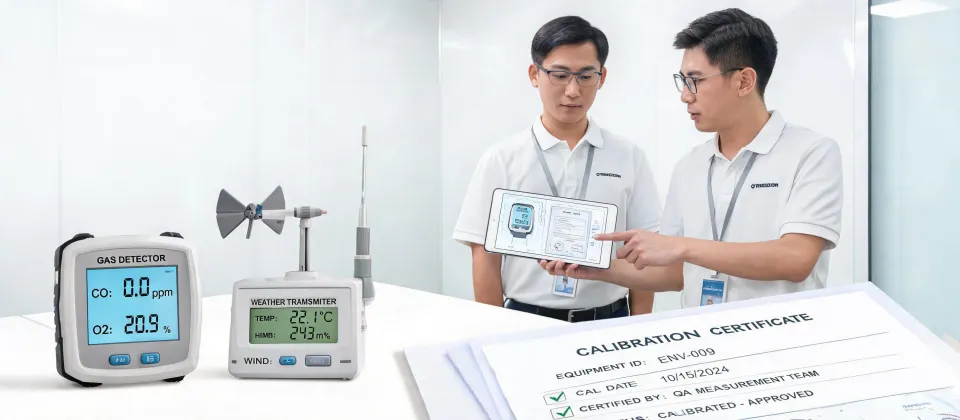
That is why calibration documentation matters. Calibration is not a manufacturing checkbox. It is a documented comparison with a reference standard, with traceability and uncertainty. Under ISO/IEC 17025, a calibration certificate should report the measurement results and the uncertainty. If a supplier says a unit is factory calibrated but cannot provide a certificate, you are not buying calibrated equipment—you are buying a promise.
Now we ask for calibration documents before accepting delivery. If the new sensor is not calibrated, we send it to an ISO/IEC 17025 accredited lab first. We compare the model code and serial number on the certificate to the label on the instrument. Dodged a bullet a few months ago when that check caught a transmitter variant that would have been connected to the wrong bus output.
The Real Cost of a Small-Order Mistake
What did our missing verification cost? The probe itself was $320. The investigation, temporary reference meter, and calibration lab visit came to about $4,800. The cleanroom was offline for most of that afternoon. The project schedule moved. Everyone remembered that an inexpensive sensor caused an expensive problem.
A pre-installation calibration check would have cost around $150. That number is now in our sensor replacement budget under "verification before use." It feels like overhead until it saves you from a $4,800 mistake.
What I Do Differently Now
I still choose Vaisala when we need long-term stability. The company's humidity and carbon dioxide sensing platforms are strong. But I no longer treat sensor purchases the same way I treat office supplies.
- Use the full product code on the existing instrument label, not a verbal description and not a fuzzy memory.
- Ask for calibration documentation before accepting shipment. Traceability to NIST or an equivalent national standard is a good baseline.
- Create an acceptance step: compare product code on the invoice to the label on the new unit and to the original sensor in use.
- Watch how the supplier handles a one-item order. If a distributor treats your small question like a waste of their time, they're telling you something about the relationship.
Small doesn't mean unimportant. The supplier that spent 10 minutes helping me choose a rotary encoder has since received much larger orders. The lab supplier that asked a clarifying question about a pipette pen is now on our preferred vendor list. Those small moments reveal which vendors will work hard when you are not their biggest customer.
So if a replacement Vaisala HUMICAP sensor drifts in your building, don't start by switching brands. Start by asking how it was selected, shipped, and verified. More often than not, the sensor is not the weak link. The invisible buying process is where the wrong turns happen.

Marcus Feld
Marcus Feld is an electrical test and measurement analyst specializing in multimeters, oscilloscopes, clamp meters, insulation testers, spectrum analyzers, and data loggers. He applies IEC 61010-2-030 and IEC 61010-031 concepts while examining measurement category, bandwidth, true-RMS response, input loading, and stated uncertainty. His work helps maintenance engineers and test teams choose safe instruments with performance suited to the signals and environments they actually measure.