How to Buy a Vaisala WXT536: A 7-Step Procurement Checklist That Actually Works
-
Step 1: Pull the WXT536 specifications from the Vaisala official website, not from reseller listings
-
Step 2: Confirm the exact model variant before asking for prices
-
Step 3: Ask what's NOT included before you ask the price
-
Step 4: Get two or three quotes, but compare them line by line
-
Step 5: Put the lead time in writing, then add buffer
-
Step 6: Verify calibration and documentation requirements before the unit ships
-
Step 7: Keep the order codes and paperwork where your successor can find them
- Common mistakes I still see
I'm the office administrator who buys everything for a 150-person environmental consulting firm—about $400,000 a year across 30-plus vendors. When I took over purchasing in 2020, I figured the hardest part would be negotiating prices. It wasn't. The hardest part is that specialty instrument orders don't come with an instruction manual.
Last year, a project manager asked me to source a Vaisala WXT536 weather transmitter for a client's rooftop monitoring system. No Amazon listing. No standard catalog page. Just a model number and a deadline. I made a couple of mistakes, wasted about two weeks—well, closer to three—and finally got it right. Here's the checklist I now use for every specialized instrument purchase. It has seven steps, and step three is the one most people skip.
Step 1: Pull the WXT536 specifications from the Vaisala official website, not from reseller listings
The first thing I did was copy specifications from a distributor's product page. The second thing I did was forward them to the project manager. The third thing I did was get an email back saying the specs didn't match what the client's engineer had sent over.
Go to the Vaisala official website (vaisala.com) and find the WXT536 product page. It links to the full datasheet PDF, and that PDF is the only source I trust for Vaisala WXT536 weather transmitter specifications anymore. Measurement ranges, output formats, operating temperature, supply voltage, the ordering code—all of it lives there. Reseller pages are summaries at best, and at worst they're outdated.
I keep the datasheet in a procurement folder and reference it in every internal email. If a quote doesn't match the datasheet, I don't accept the quote. That rule has never failed me.
Step 2: Confirm the exact model variant before asking for prices
The WXT530 series is a family of weather transmitters, and the models look almost identical in photos. The WXT536 is the full six-parameter version: wind speed, wind direction, liquid precipitation, barometric pressure, temperature, and relative humidity. It does all of that with no moving parts, which is why it's popular for industrial and rooftop weather monitoring.
But other models in the series cover only a subset of those parameters. A reseller might see “WXT536” on your request and quote a different variant that's in stock—or, more commonly, they just assume every WXT3xx model is the same. I once received a quote for a different order code than the one I requested. The difference didn't look like much on paper, but it would have meant a unit without the full measurement set.
Always put the complete ordering code in your request, and ask the vendor to confirm it back in writing.
Step 3: Ask what's NOT included before you ask the price
This is the step everyone skips. I did too, the first time.
The base price of a Vaisala WXT536 is not the price you pay. The first invoice I reviewed had line items I didn't anticipate:
- Mounting bracket and solar radiation shield (listed as optional accessories)
- A specific cable length with the connector pre-wired
- Calibration certificate (yes, the certificate was a separate line item)
- Shipping, handling, and customs paperwork fees
I've learned to ask “what's NOT included” before “what's the price.” The vendor who lists all fees upfront—even if the total looks a little higher—usually costs less in the end. The vendor who sends a beautiful low quote and then adds a surprise line item for the radiation shield is not saving you money; they're just hiding the cost from the initial comparison. I see this constantly across all kinds of instrument categories. It's not exclusive to Vaisala.
Step 4: Get two or three quotes, but compare them line by line
For our first WXT536 order, I requested quotes from three authorized distributors. The total prices varied by about 35% for what looked like the same item—I want to say the spread was roughly a third, but don't quote me on the exact numbers. The “cheapest” quote didn't include the mounting kit or the calibration certificate. The most expensive one did, plus a longer warranty period.
I now create a simple spreadsheet with one row for every component: unit, bracket, radiation shield, cable, certificate, shipping, estimated delivery date. Then I compare totals, not unit prices.
A quick note on proximity sensors—another thing I get asked about constantly: “What's a good proximity sensor price?” The answer depends entirely on what's included. An inductive proximity sensor from a decent brand looks expensive compared to a no-name one, until you factor in the mounting brackets, connectors, and the fact the no-name one might fail after eight months. The same line-by-line comparison rule applies. I now apply this mindset to everything from ifm inductive sensors to a digital earth resistance tester for our electrical team.
Step 5: Put the lead time in writing, then add buffer
“Lead time” means when the unit ships from the factory, not when it arrives at your loading dock. For a unit coming from Finland to the United States, the quoted lead time of three to four weeks turned into six weeks once freight schedules and customs got involved.
I don't have hard data on how often international shipments arrive late, but based on the 60-80 orders I process annually, my sense is that a third of them slip by at least a week. My rule now: quote the internal requester the vendor's lead time plus two weeks, and put that expected date in the order notes. If it arrives early, everyone thinks you're a hero. If it's late, you've already set the expectation.
Step 6: Verify calibration and documentation requirements before the unit ships
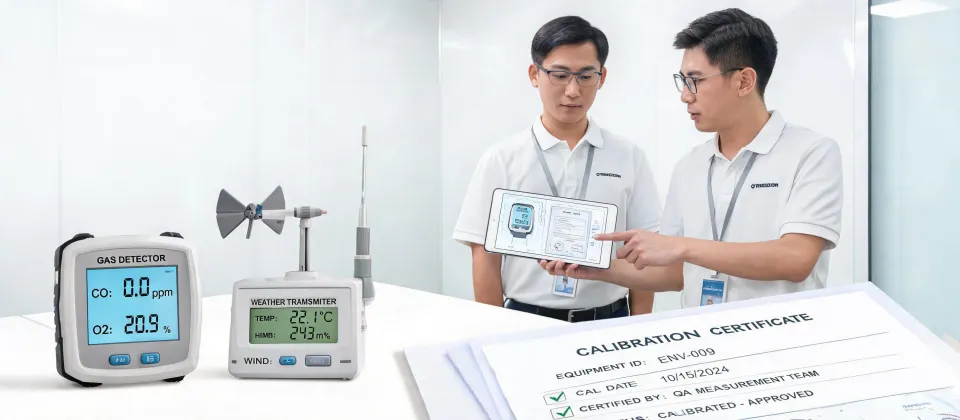
Many environmental monitoring contracts require NIST-traceable calibration documentation. The WXT536 can be ordered with a factory calibration certificate, but it isn't always automatic. You have to select it when you place the order.
In 2024—specifically around May of that year, I remember because it put a whole project at risk—our operations manager rejected a delivery because the calibration certificate wasn't in the box. The unit sat in our warehouse for ten days while the vendor issued the paperwork. That delay cost us more than the certificate would have.
If your customer or QA team will ask “is there a calibration certificate?”, ask that question before you order, not after delivery.
Step 7: Keep the order codes and paperwork where your successor can find them
This is the step nobody talks about. A year from now, someone will ask “what weather station did we install, and what's the part number for the rain sensor?” If the answer lives in your personal inbox, you'll be digging for an hour.
I put every instrument order in a shared folder: the datasheet PDF, the quote, the invoice, the calibration certificate, and the final order code. (I really should have done this from day one—it took me longer than I'd like to admit to build that habit.) Once it was in place, internal requesters stopped emailing me for information. They just check the folder.
Common mistakes I still see
Assuming an “official-looking” website is actually official
Search for a Vaisala WXT536 and you'll find reseller pages that look almost identical to the Vaisala official website. Some are legitimate authorized distributors. Some are not. Check the URL, check for the authorized partner badge, and when in doubt, contact Vaisala directly and ask for authorized resellers in your country.
Ordering from a marketplace before checking the manufacturer's channel
One of our machine builders recently asked me where to buy ifm inductive sensors online. I didn't send him to a marketplace. I went to ifm's website first, found their distributor locator, and contacted two local distributors. Marketplace listings can be grey-market stock with no warranty backing. The official channel is worth the extra two days.
The same logic applies to a digital earth resistance tester, a Vaisala humidity transmitter, or any piece of equipment that feeds data into a client deliverable. If the instrument matters, buy it through a channel that can prove provenance and provide support.
Letting the cheapest quote be the deciding factor
The lowest number on a quote is not the lowest cost. It's just the lowest number. The most frustrating part of this job is watching a colleague bring in a “great deal” on an instrument, only to spend twice the savings on accessories, expedited shipping, and certificate re-issuance. Transparent pricing—where every line item is visible at the start—is worth paying for.
There's something genuinely satisfying about a well-executed instrument order. After all the spec-checking, quote-comparing, and paperwork, the unit arrives on time, with the right documentation, and no hidden cost surprises. That's the payoff. It's not glamorous work, but it's how you build vendor relationships that don't keep you up at night.

Marcus Feld
Marcus Feld is an electrical test and measurement analyst specializing in multimeters, oscilloscopes, clamp meters, insulation testers, spectrum analyzers, and data loggers. He applies IEC 61010-2-030 and IEC 61010-031 concepts while examining measurement category, bandwidth, true-RMS response, input loading, and stated uncertainty. His work helps maintenance engineers and test teams choose safe instruments with performance suited to the signals and environments they actually measure.