How I Validate Sensor Specs Before a Big Purchase: A 3-Step Checklist for Quality Engineers
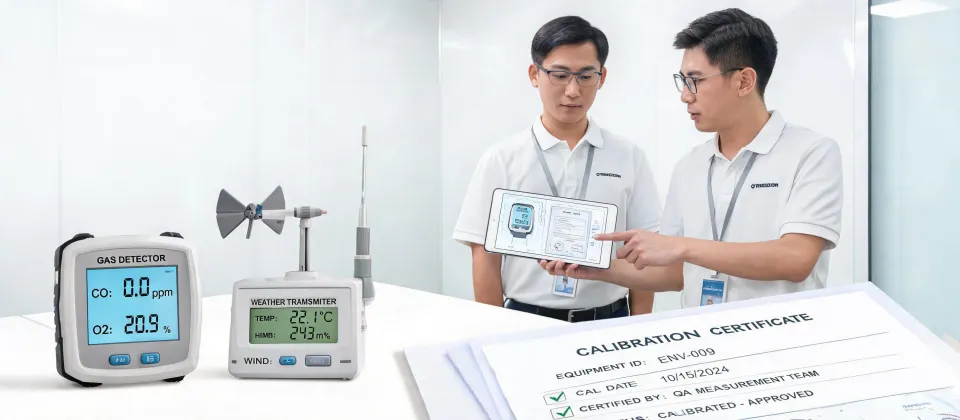
I'm a quality compliance manager at a midsize industrial automation firm. Part of my job is reviewing every measurement instrument that enters our facility—roughly 200+ unique items annually. In Q1 2024 alone, I rejected 12% of first deliveries because the specs didn't match the sales sheet.
This checklist is for anyone who's ever received a temperature sensor that drifts more than promised, or a CO2 sensor that fails in real-world humidity. It's the process I use when comparing Vaisala sensors against alternatives—and it's saved us from about $18,000 in rework over the last 18 months.
There are three steps. Each one has a concrete check you can run before you place the order.
Step 1: Verify Accuracy Claims Against Known Standards
The first thing I do is strip away the marketing language. Every sensor manufacturer claims 'high accuracy'—but that term means different things at 25°C vs. 55°C, or at 20% RH vs. 90% RH.
Here's what I check:
- What standard is the accuracy referenced to? Most reputable brands (Vaisala included) calibrate against ISO 17025 accredited labs. If a datasheet just says '±0.2°C' without stating the traceability standard, that's a red flag. Source: ISO 17025:2017, section 5.5.
- Does the accuracy hold across the full temperature range, or only at reference conditions? I've seen budget sensors quote ±0.3°C at 25°C, but the actual drift exceeds ±1.2°C at -20°C. Vaisala's HMP series, for example, publishes accuracy curves, not just single-point numbers.
- Long-term stability data. A sensor that's accurate on day one but drifts 0.5% per year is not 'accurate' in any practical sense. Request the 10-year drift projection—most European vendors will share it. If they can't, or won't, move on.
Real-world check: In August 2023, we evaluated a competitor's CO2 sensor (not Vaisala, not naming names). Their datasheet claimed '±30 ppm +3% of reading.' But when we tested it against a certified gas standard at our lab, the error was 48 ppm at 800 ppm CO2—a 6% error, double the claim. We returned the batch.
Step 2: Check Environmental Compatibility—Not Just Specs
This is the step most buyers skip. They check accuracy, maybe price, and stop. But the real cost comes when a sensor fails in the actual environment.
Here's my checklist for environmental compatibility:
- Dew point vs. relative humidity: If you're measuring in a cold storage warehouse (like we do), dew point sensors often outperform RH-based humidity transmitters. Vaisala's DMT series is built for this. But I've seen buyers spec a standard RH transmitter for a -30°C freezer—it failed within a week because the internal electronics condensed.
- Pressure and altitude effects: Many CO2 sensors (including some Vaisala models) use non-dispersive infrared (NDIR) technology, which is pressure-dependent. If your site is at 2,500m elevation, the reading can shift by 5-7% without compensation. Always ask: 'Does this model include barometric compensation?' Vaisala's GMP252 does; their GMP251 does not.
- Chemical exposure: Sensors in pharmaceutical clean rooms see hydrogen peroxide vapor. Sensors in agricultural barns see ammonia. Both can degrade the sensing element. Check the chemical resistance datasheet—if it's not published, consider it a risk.
Mindshift moment: I didn't fully understand the value of environmental compatibility until a $3,000 order of temperature transmitters came back completely wrong. The vendor said they were 'general purpose.' Our application involved intermittent exposure to 95% RH at 40°C—well within the 'general' spec. But the PCB corroded in six months. Now every contract includes a line-item for environmental suitability.
Step 3: Validate the 'Hidden' Specs—Response Time, Warm-Up Drift, and Output Resolution
These are the specs that never make it into comparison charts, but they determine whether a sensor works in your actual process.
- Response time (t63 or t90): A CO2 sensor with a t90 of 2 minutes is useless for real-time control in a greenhouse, where CO2 levels change every 30 seconds. I always request the full response curve, not just the headline number. Vaisala publishes t63 and t90 values for their GMP series. Many budget vendors only give a single number with no temperature dependency.
- Warm-up drift: Most sensors need time to stabilize. I've tested a transmitter that drifted 0.8% over the first 4 hours after power-on. The datasheet didn't mention it. For critical applications, specify a mandatory 1-hour warm-up and stabilization period in your purchase order.
- Output resolution and noise: A 4-20 mA loop with 0.1% resolution may look fine, but at 16-bit resolution, the actual noise floor can mask small changes. For applications requiring ±0.1°C accuracy, you need at least 0.01°C resolution at the output. I check this by requesting the digital output format (e.g., Modbus RTU raw counts) and verifying the least significant bit value.
Comparison insight: In 2022, we ran a blind test comparing three CO2 sensors (Vaisala GMP252, a Japanese brand, and a Korean brand) in a controlled climate chamber. All three were within spec at 25°C and 50% RH. But when we dropped the temperature to 5°C, the Korean sensor's response time went from 60 seconds to 195 seconds. The Vaisala sensor changed from 60 to 72 seconds. Same price range, dramatically different real-world performance.
Common Mistakes to Avoid
Mistake #1: Only checking accuracy at one point. A sensor is only as good as its performance across your actual operating range. Always ask for multi-point data.
Mistake #2: Ignoring the calibration certificate detail. I've seen 'NIST traceable' certificates that were actually traceable to the vendor's internal lab, not NIST. A genuine certificate lists the reference standard and its uncertainty budget. If the cert says 'calibrated with equipment traceable to NIST' without naming the reference instrument, it's not trustworthy.
Mistake #3: Assuming 'European brand' means identical quality across models. Vaisala, for example, has different product lines (HUMICAP, DRYCAP, CARBOCAP)—each optimized for different applications. The wrong model selection can cost you 10x the sensor price in calibration rework. I learned that the hard way when we spec'd a humidity transmitter for a high-temperature oven, using a model rated to 80°C, but the probe assembly wasn't rated for the radiant heat. The electronics melted within 8 hours. That mistake cost us $22,000 in process downtime and a rush replacement.
The Bottom Line
I've been doing this for four years, and I still get surprised by what datasheets don't say. The vendors who list all the caveats upfront—response time dependency, warm-up drift, environmental limits—are the ones I trust more. Even if the total price looks higher, they usually cost less in the long run.
Prices as of January 2025: Vaisala CO2 sensor GMP252 (no display) ranges from ~$350–420 depending on distributor; the GMP251 is ~$280–340. Verify current rates—distributor pricing varies significantly. For temperature sensors like the PT100-based HMP1 probe, expect $180–250. Pressure sensors (like the BAROCAP PTB330) start around $900.
One last thing: if a vendor can't answer these three questions in writing, move on. There are too many good options—Vaisala included—to waste time on ones that hide the details.

Marcus Feld
Marcus Feld is an electrical test and measurement analyst specializing in multimeters, oscilloscopes, clamp meters, insulation testers, spectrum analyzers, and data loggers. He applies IEC 61010-2-030 and IEC 61010-031 concepts while examining measurement category, bandwidth, true-RMS response, input loading, and stated uncertainty. His work helps maintenance engineers and test teams choose safe instruments with performance suited to the signals and environments they actually measure.