A Practical Checklist for Buying Vaisala Dew Point Transmitters (From Someone Who's Ordered 200+ Sensors)
-
Who This Is For
-
Step 1: Verify the Measurement Range (Don't Assume Standard)
-
Step 2: Match the Output Signal to Your System
-
Step 3: Confirm the Pressure Rating (It's Not Just About the Sensor)
-
Step 4: Factor in the Calibration Certificate (Don't Skip This)
-
Step 5: Check the Expected Lead Time (It's Changed)
-
Common Mistakes to Avoid
Who This Is For
If you're an office administrator, lab manager, or facilities buyer who's been tasked with sourcing dew point sensors for the first time (or the tenth), this checklist is for you. I manage environmental monitoring equipment procurement for a mid-sized pharma services firm—roughly $120k annually across 15 vendors. Our lab teams rely on Vaisala DMT series transmitters for dry air monitoring in HPLC systems. Get it wrong, and production stops.
I've processed over 200 sensor orders in the last 4 years. Below is my 5-step checklist for buying Vaisala dew point transmitters—specifically the DMT152, DMT143, and DMT340 models we use. Read this before you click "add to cart."
Step 1: Verify the Measurement Range (Don't Assume Standard)
Everything I'd read about Vaisala said their dew point transmitters are "high accuracy, wide range." In practice, the standard range on a DMT152 is -70 to +30 °C Td, but if you're monitoring below -60 °C Td for your compressed air system, you need the extended range option (DMT152-1).
I only believed this after ignoring it once and receiving a unit that maxed out at -60 °C Td. Our application needed -80 °C Td capability for a new freeze-dryer validation. The sensor was technically within spec, but it couldn't measure our actual dew point. That cost us a $1,200 return shipping fee and 3 weeks of downtime.
Check before ordering: What's the actual lowest dew point your process sees? Vaisala's standard ranges cover most applications, but if you're below -60 °C Td, confirm the "Extended Range" variant.
Step 2: Match the Output Signal to Your System
This one sounds obvious, but I've seen it trip up even experienced buyers. Vaisala dew point transmitters offer multiple output options: analog (4–20 mA), digital (RS-485 with Modbus), and relay outputs.
For our HPLC 1100 systems, we use the analog output because the older chromatography data system only accepts 4–20 mA. But in 2024, when we consolidated monitoring across 3 facilities, we standardized on Modbus RTU for centralized trending. The DMT143 has a version with both analog and digital outputs (the DMT143L), but the DMT152 only offers analog by default—you have to specify the DMT152-1 for Modbus.
Action: Get the PLC/DCS I/O type from your engineering team before ordering. Don't assume "it'll work." It won't.
Step 3: Confirm the Pressure Rating (It's Not Just About the Sensor)
The DMT340 is rated for up to 40 bar. But the DMT152 is only rated to 10 bar. If you're putting a transmitter on a pressurized line (common in ion chromatography applications where carrier gas purity matters), that's a critical spec.
I made this mistake in 2023. We ordered DMT152 units for our pharmaceutical manufacturing lines. The standard sensor can measure down to -70 °C Td at 10 bar, but our clean dry air supply runs at 15 bar. The transmitter wasn't damaged, but the accuracy spec changes above rated pressure. Vaisala's documentation says accuracy is only guaranteed within the rated pressure range. I had to expedite a DMT340—costing us $480 in overnight shipping and a scolding from the VP of Operations.
Pro tip: If your application is above 10 bar, skip the DMT152 and go straight to the DMT340. The price difference ($850 vs $1,400) is less than the cost of a failed installation.
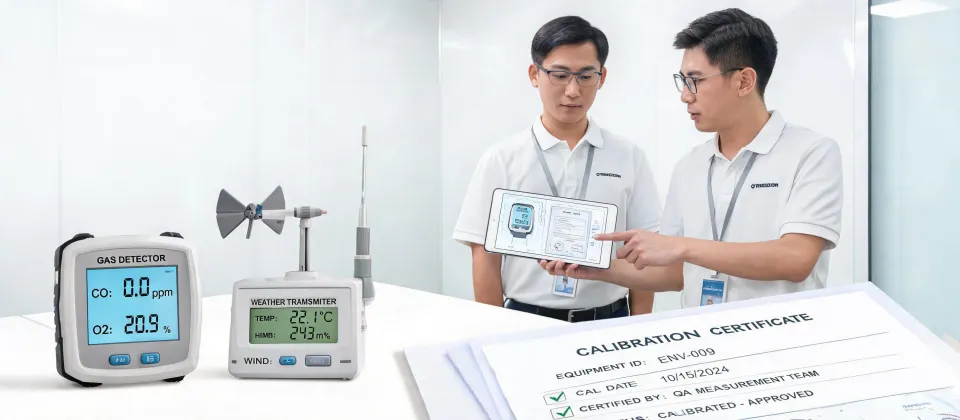
Step 4: Factor in the Calibration Certificate (Don't Skip This)
Most of us assume sensors come with a calibration certificate. They do—but sometimes it's a "manufacturer's certificate" and not a "traceable certificate." For our pharma clients, we need a certificate traceable to national standards (like NIST).
When I took over purchasing in 2020, I ordered 10 DMT143 units from a distributor at a great price—$3,800 total. When they arrived, the certificates were generic factory documents. Our QA team rejected the entire shipment. The vendor couldn't provide traceable certs for those units (they were older stock). We had to reorder from a different source at full price. I ate the restocking fee.
What to ask: "Is the calibration certificate traceable to NIST?" Vaisala offers this as an option (usually +$60–$100 per unit). If you're in regulated industries (pharma, aerospace, food processing), order immediately.
Step 5: Check the Expected Lead Time (It's Changed)
The conventional wisdom in 2021 was "Vaisala sensors? 2 weeks max." In 2025, that's wishful thinking. Supply chain issues have hit semiconductor components hard. The DMT152 uses a unique mirror technology that requires a specific chip. Lead times have stretched to 8–12 weeks for some models.
I only learned this after ignoring it and needing a DMT340 for a compressor upgrade last November. The distributor said "stock"—but the stock was a different variant. By the time I realized, we'd lost 4 weeks. We ended up renting a competitor's unit at $400/month while waiting.
Check before ordering: Ask for lead time on the exact model number. Vaisala's website lists "standard lead times," but they aren't always accurate. My go-to is to email the distributor with the exact part number and ask: "Is this in physical stock, or do you need to order from Finland?"
Common Mistakes to Avoid
- Mistake #1: Assuming all Vaisala sensors use the same connector. The DMT152 uses a 6-pin M12 connector; the DMT143 uses an 8-pin M12. They look similar but aren't interchangeable.
- Mistake #2: Ordering a transmitter without the display option if your operators need local readings. The DMT340-1 (display) is $200 more but saves calls to engineering every time.
- Mistake #3: Not checking if the probe cable is long enough. We ordered a DMT143 with a 10-meter cable option for a cleanroom installation—only to realize we needed 20 meters. Extension cables exist, but they add another $150 and a potential signal noise issue.
- Mistake #4: Forgetting to ask about warranty. Vaisala offers a standard 2-year warranty, but some distributors offer 3-year extended for ~10% of the unit price. For critical applications, it's worth it.
One more thing: Calibrating Vaisala sensors is straightforward with the reference software (MI70 Link), but you need a separate humidity generator if you're handling it internally. We outsource calibration to a local lab—$180 per unit every 12 months. For us, that beats buying the equipment.

Marcus Feld
Marcus Feld is an electrical test and measurement analyst specializing in multimeters, oscilloscopes, clamp meters, insulation testers, spectrum analyzers, and data loggers. He applies IEC 61010-2-030 and IEC 61010-031 concepts while examining measurement category, bandwidth, true-RMS response, input loading, and stated uncertainty. His work helps maintenance engineers and test teams choose safe instruments with performance suited to the signals and environments they actually measure.