Why Your Weather Station Data Keeps Failing In The Field – And What To Check Before The Sensor Ever Ships
-
The Surface Problem: "The Sensor Was Wrong"
-
The Deeper Problem: Nobody Verified The Environmental Envelope
-
When "Brand Quality" Isn't The Point
-
The Real Cost: Not What You Think
-
The Hidden Culprit: The "One-Time Calibration" Assumption
-
What Actually Works: Check Early, Check Often
-
Turning Something Around: The Second Shipment Incident
-
Small Investments Early In The Process Prevent Bigger Costs Later On
If you've ever watched a data log for two weeks and realized the weather station you installed has been drifting since day one—you know that sinking feeling. The data is wrong. The graphs don't make sense. The client is asking questions. And somewhere in the back of your mind, you're wondering if you made a mistake with the equipment choice.
I've been on both sides of this. I review inbound sensor shipments for a living—specifically environmental monitoring equipment. And I can tell you, most field problems aren't actually field problems. They're detection problems. The equipment wasn't bad. The verification process was missing.
The Surface Problem: "The Sensor Was Wrong"
When someone contacts us about a failed project, the story almost always starts the same way. The weather station didn't hold up. The readings were off by more than the spec sheet promised. The sensor died after a season of use.
I've seen this from the receiving dock perspective. A batch of forty humidity transmitters arrives. The paperwork is correct. The calibration certs are included. It all looks fine. But then we actually check them—and the instability is visible right from the start.
The equipment gets blamed. The brand gets blamed. But honestly, in my experience, the bigger issue is usually upstream.
The Deeper Problem: Nobody Verified The Environmental Envelope
Here's what I learned the hard way. There's a difference between functional testing and environmental verification. Functional testing answers the question "does this sensor read the right humidity at room temperature?" Environmental verification answers a harder question: "does this sensor hold its accuracy across the temperature range it will actually experience?"
We didn't have a formal environmental verification process for incoming shipments for a long time. Cost us when a batch of pressure sensors looked perfect on the bench but produced suspicious readings once installed in a heated enclosure in a cold climate. The spec sheet said one thing. The actual behavior at temperature extremes said another.
The third time something like that happened, I finally created a verification checklist. Should have done it after the first time.
When "Brand Quality" Isn't The Point
Let's talk about the brand for a second. Vaisala is a well-known Finnish instrument manufacturer. They've been around since 1936. Their weather stations and environmental sensors are used in demanding applications—meteorological networks, road weather systems, industrial processes. For good reason. The engineering is solid.
But here's something I've learned over four years of reviewing sensor shipments: even the best manufacturer's product can fail in the field if the storage and inspection conditions before installation were wrong. Humidity sensors are particularly sensitive. They drift if exposed to condensation. They pick up contaminants if stored without protection. I've seen a shipment of high-end transmitters ruined because the warehouse stored them directly on a concrete floor in a humid environment for three weeks before installation.
The sensor wasn't bad. The process was bad.
The Real Cost: Not What You Think
People focus on the cost of the equipment. A Vaisala weather station is an investment—depending on the model, that can be a significant capital line item. But the equipment cost is almost never the real expense when things go wrong.
The real cost is the rework chain. If your monitoring data is suspect, you don't just replace a sensor. You re-validate the site. You re-run the analysis. You write exceptions into the report. Maybe you extend the commissioning timeline. I've seen a $2,000 sensor issue turn into a $22,000 project redo and a delayed launch. That's not hypothetical—that was a quality issue we caught on a project in 2023.
There's also the softer cost. Trust. When you tell a client "the data from the previous two weeks isn't reliable," you lose something. It doesn't matter whose fault it was. The relationship changes.
The Hidden Culprit: The "One-Time Calibration" Assumption
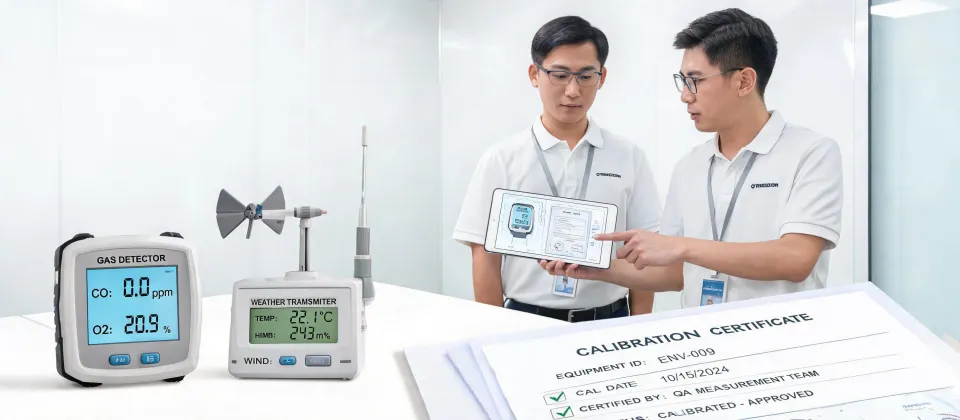
Here's a misconception I run into constantly—and honestly, it's the one I care most about. People assume that a traceable calibration certificate means the sensor will stay accurate in the field for a year. That's not how it works.
A calibration certificate tells you the sensor met its spec at the moment of testing, under controlled laboratory conditions. It does not guarantee long-term drift performance in a real-world environment. For critical applications, you need to understand the sensor's tolerance drift behavior. Some sensor types hold accuracy for years. Others—especially humidity sensors—drift more noticeably over time.
I'm not saying manufacturers hide this. Most spec sheets include long-term stability data. But I've seen many projects where the verification plan just assumed the initial calibration would hold. That assumption can cost you.
What Actually Works: Check Early, Check Often
In my experience, the projects that go smoothly have one thing in common: they verify early. Before installation. Before commissioning. Before the data matters.
Here's what I'd recommend, based on what we do on the receiving side:
- Verify upon receipt. Don't assume the calibration cert matches the actual unit. Check serial numbers. Check firmware versions. We caught a mismatch on a batch of data loggers last year—the certs were for a different revision level. Caught it before it went to the field.
- Know your environmental envelope. If the sensor will operate at -20°C but your verification is at +22°C, you're not testing the real conditions. This is especially relevant for weather stations and outdoor sensors. The WXT536, for example, is designed for a wide temperature range—but if you're installing it somewhere with extreme conditions, a bench check at room temperature doesn't tell you much about field performance.
- Plan for drift. Ask yourself: what happens if this sensor drifts 2% over its first year? Is that acceptable for your application? If not, build in a verification schedule early. 5 minutes of verification checks beats 5 days of field troubleshooting.
Turning Something Around: The Second Shipment Incident
I'd like to share a story, because it changed how I think about this.
A few years ago, we received a batch of humidity and temperature transmitters from a European manufacturer. The spec sheet was solid. The brand was reputable. The paperwork looked perfect—right up until we actually started checking.
Turns out the transmitters were not the standard version. They were a variant with a different connector configuration, which we'd never specified. The vendor claimed it was "within industry standard." We rejected the batch. The vendor redid it at their cost. Now every contract includes connector configuration in the verification checklist.
But here's what struck me: if we hadn't caught that, the installers would have been at the job site with transmitters that didn't match the enclosures. That would have been a project delay measured in days, not hours. And it would have been framed as a "factory error"—but the real error was our process for double-checking before shipping.
That experience also changed my mind about something. I used to think that checking at the start of the supply chain was the most important gate. Now I think the most important gate is the hand-off point—the moment when equipment moves from the shipping crate to the installation crew. If there's a gap between what the manufacturer verified and what the installer assumes, that's where errors slip through. It's basically a game of telephone, and nobody wants to be the one who miscommunicates the calibration data.
Small Investments Early In The Process Prevent Bigger Costs Later On
1% of the total project budget spent on verification upfront can save you from ambiguous field data that costs you a month of analysis time. That's the trade-off I see all the time. A modest investment in education and testing procedures ahead of time prevents a far larger cost in false starts, repeat work, and corner cutting later.
Here's the thing I want to leave you with. After about 200+ shipments and hundreds of projects, I've come to believe that the 'best' sensor isn't the one with the most impressive spec sheet—it's the one you have a complete understanding of before you deploy it. The technology matters, but your own verification process matters more. And that's not something any manufacturer can ship to you. It's something you have to build into your workflow.
Take it from someone who's done a lot of receiving inspections: the weather station is never the real problem. The problem is the gap between zero verification and too much trust in paper certificates. That's one fix you can implement today, and it'll pay for itself the first time it catches a discrepancy. Trust me on that one.

Marcus Feld
Marcus Feld is an electrical test and measurement analyst specializing in multimeters, oscilloscopes, clamp meters, insulation testers, spectrum analyzers, and data loggers. He applies IEC 61010-2-030 and IEC 61010-031 concepts while examining measurement category, bandwidth, true-RMS response, input loading, and stated uncertainty. His work helps maintenance engineers and test teams choose safe instruments with performance suited to the signals and environments they actually measure.