Vaisala WXT536 Weather Station Price Is the Least Important Number. Here's Why.
I Work With Deadlines. Here's What I've Learned.
If you've ever called a distributor at 4 p.m. on a Friday needing a part by Monday, you know the feeling. I'm on the other end of that call. I coordinate rush orders for industrial measurement equipment. Not the most glamorous job, but it keeps me honest. Last quarter alone, we processed 47 rush requests with a 95% on-time rate. Most of them were for Vaisala products.
Here's a confession: when you call me for a quote with a deadline breathing down your neck, I'm glad to help. But I also know most emergency purchases happen because the requirements were never clearly defined.
The Vaisala WXT536 weather station price is the least important number in your purchase decision. What you plan to measure, how long you'll trust the data, and whether the instrument actually fits your environment—those matter far more. And the sooner you accept that, the fewer rush orders you'll ever place.
The WXT536 Price Question Is Really a Value Question
Let's talk about the WXT536 itself. It's the workhorse of Vaisala's weather transmitter line: six essential parameters in one compact enclosure. Wind speed, wind direction, precipitation, temperature, relative humidity, and barometric pressure. No moving parts for wind—it uses ultrasonic sensing—and the rain sensor detects individual raindrops. That design is why the WXT536 shows up on wind farms, airports, road weather networks, and construction sites.
The question I get most: "what does it cost?"
As of January 2025, a complete WXT536 setup typically lands between $4,000 and $7,000, depending on mounting kit, cable length, output options, and whether the order includes a factory calibration certificate. Not an official price list—just the realistic planning range from our order system.
But here's what the person asking usually misses. Most buyers focus on per-unit pricing and completely miss setup fees, installation time, communication compatibility, maintenance schedules, and the cost of future recalibration. I've seen a client save $2,000 on a station and burn through $4,000 in engineering time trying to make the data format match their SCADA system.
One buyer skips the calibration certificate and saves $600. Eight months later, the humidity reading drifts. No one notices until an audit rejects the whole dataset. The investigation takes two weeks, the report gets tossed, and the project deadline moves. That's the math nobody puts in the spreadsheet.
The question everyone asks is "what's your best price?" The question they should ask is "what's included in that price?" And then: "can I verify that the measurement is right, six months from now?"
Everything Is "a Sensor" Until It Isn't
A few months into the job, a client called in genuine alarm. "We need an inductive sensor m8 on the line," he said. "Our automation vendor quoted 14 weeks of lead time. Can you help?"
I had to pause. M8 isn't a measurement specification—it's a housing thread size. An inductive sensor m8 is a proximity switch, 8 mm in diameter, used to detect metal objects. It doesn't measure weather, temperature, or humidity. It's an on/off presence detector.
He wasn't stupid. He just didn't know there are separate worlds inside the word "sensor." And that's the root of most purchasing mistakes I see.
The most frustrating part of that call: he was one signature away from approving an expedited order for the wrong part. You'd think a broken production line would lead with the symptom, not a part number. It didn't. That call changed how I handle every request since. I ask what the customer's actual problem is, not just what part they've been told to order.
Same week, another customer asked us to source a "CMM machine" for their quality lab. A coordinate measuring machine. Before anyone in metrology can quote one, they need to know: bridge type or gantry? Contact probing or optical? Part size, tolerance, temperature control? The first quote from our partner would have been a poor fit if the customer hadn't paused to answer those questions.
Why am I telling you this in an article about weather stations? Because the same confusion shows up every day in environmental measurement. People ask for "a weather sensor" without specifying which parameter matters most. I've lost count of calls asking for "a weather station for a greenhouse." OK: temperature, humidity, CO2? Do you need ventilation control input? What power is available at the mounting point? The answer is rarely a single model. It's a system.
I'd rather spend 10 minutes explaining options than deal with mismatched expectations later. An informed customer asks better questions and makes faster decisions. That's not just a nice idea—it's the only thing that keeps an emergency desk from turning into a warehouse of returns.
What Vaisala Products Actually Buy You
Vaisala's reputation for accuracy and long-term stability comes from engineering, not luck.
Take the HUMICAP sensor in many Vaisala humidity and temperature transmitters. It's a capacitive thin-film polymer sensor designed to resist condensation, dust, and chemical vapors. The heated version goes further: it burns off contamination and keeps measuring even in conditions that would kill a cheaper sensor. That doesn't mean it runs forever without care—no sensor does. But the drift that shows up in low-cost transmitters after three months in a coastal environment just doesn't show up the same way here.
That stability is built into the WXT536, too. It's why a wind farm operator doesn't want to rely on a cheap station: when maintenance decisions depend on gust data, a 2 m/s error costs real money.
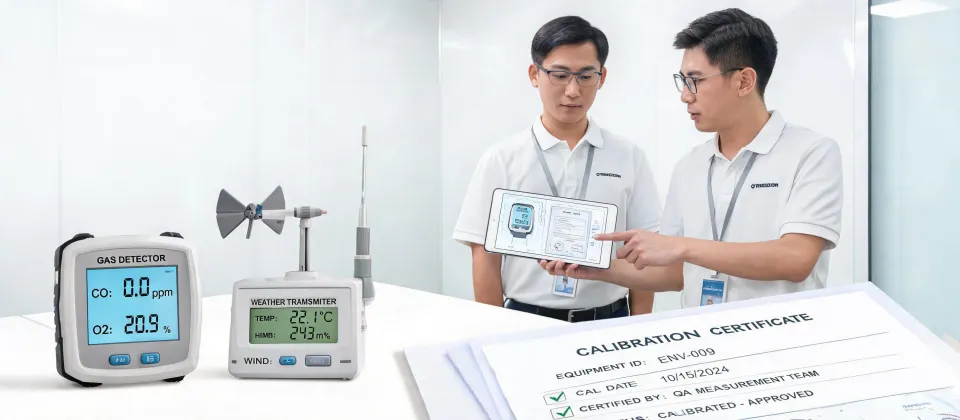
What I mean is that the price of a Vaisala instrument includes verifiable performance. A calibration certificate traceable to ISO/IEC 17025. Documented accuracy. A reference you can defend in an audit or a regulatory review. You're not buying a part; you're buying a measurement you can trust. The same logic runs through the rest of the Vaisala product line: dew point meters for compressed air, barometers for weather networks, data loggers for cold chains, CO2 sensors for HVAC. Each one earns trust the same way—documented accuracy, long-term stability, and a spec you can verify.
Can You Use a Megger Without Knowing What You're Testing?
Let me answer a question I hear often: how to use a megger insulation tester. The mechanics are straightforward. De-energize the equipment. Isolate it. Connect the test leads. Select the test voltage. Press the button. The meter applies a high DC voltage and shows insulation resistance in megohms.
But knowing the button sequence isn't the same as knowing what you're checking. Do you apply 500 V or 1000 V? That depends on the equipment's rated voltage. What counts as a pass? It depends on insulation type, temperature, and age. Test an old motor at the wrong voltage and the result tells you almost nothing.
You'd never test a live motor. So why buy a weather station without checking the environment it'll live in?
Same principle, different instrument. You can read the manual and connect the wires, but the real skill is understanding the measurement well enough to recognize a bad reading. That's the difference between owning an instrument and trusting it.
But What About Real Emergencies?
I can hear someone saying: "Nice, but my project starts in 36 hours and I need a weather station now."
Fair. I live in that world. In March 2024, a client called with exactly that problem. Their field trial was starting Friday morning, the outdoor measurement setup had failed during testing, and they needed a WXT536 on site. Normal lead time was ten working days. We got it delivered in 36 hours with an express shipment and a favor from the supplier. Rush fees added about $800 to the total. The alternative was losing a $12,000 field trial contract.
I'll always work a genuine rush order. But notice what made that one possible: the client knew exactly what they needed. Outputs, mounting, power supply, logger compatibility. The emergency was logistical, not educational.
In my experience, the customers with the fewest last-minute disasters are the ones who asked the most questions before the purchase. Not the ones who bought the fastest.
Bottom Line
Look, I make money when you place rush orders. But I'd rather help you buy the right instrument once than process a return six weeks later. That's true whether it's a weather station, an inductive sensor m8, a CMM machine, or an insulation tester.
The Vaisala WXT536 weather station price is easy to find. Understanding what you need, why you need it, and how the instrument proves its accuracy over time—that's the hard part. Do that work before you call me, and you'll probably never need my emergency desk at all.
Trust me on this one. I've watched this movie many times.

Marcus Feld
Marcus Feld is an electrical test and measurement analyst specializing in multimeters, oscilloscopes, clamp meters, insulation testers, spectrum analyzers, and data loggers. He applies IEC 61010-2-030 and IEC 61010-031 concepts while examining measurement category, bandwidth, true-RMS response, input loading, and stated uncertainty. His work helps maintenance engineers and test teams choose safe instruments with performance suited to the signals and environments they actually measure.