How to Buy Precision Instruments for Your Lab or Plant: A 5-Step Checklist for Non-Specialist Buyers
-
Who This Checklist Is For
-
Step 1: Confirm the Exact Spec, Not Just the Part Number
-
Step 2: Verify the Source—Official or Authorized Only
-
Step 3: Compare Total Cost—Not Just Unit Price
-
Step 4: Check for Hidden Compatibility Issues
-
Step 5: Verify Invoicing and Documentation Capability
-
Common Mistakes to Watch For
Who This Checklist Is For
This is for the person who gets handed a requisition for a Vaisala sensor, an encoder, a multimeter, or a micrometer—and has maybe 20 minutes to figure out what to order. You're not an engineer. You're the one who makes sure the lab or plant floor has what it needs, on time, without blowing the budget.
I've been doing this kind of purchasing for about 4 years now. When I took over in 2021, I made every mistake in the book. This checklist is basically what I wish someone had handed me on day one. It covers 5 steps, and at least one of them is probably something you're not thinking about.
Step 1: Confirm the Exact Spec, Not Just the Part Number
This sounds obvious, but it's where most problems start. Someone emails you: "We need a Vaisala HMT330." Great. But the HMT330 series has about 40 variants—different probe lengths, output options, cable types. Or they say "encoder" without specifying incremental vs. absolute, resolution, or shaft size.
What to do: Before you even open a browser, ask the requestor three things:
- The exact model number (not just the series)
- Any special options (probe type, output format, cable length)
- What it's replacing (if anything)
Most buyers focus on the price and completely miss that the wrong variant might physically not fit or electrically not interface. An encoder with the wrong shaft diameter isn't a bargain—it's a $200 paperweight.
Step 2: Verify the Source—Official or Authorized Only
Here's where I learned a hard lesson. I found a great price on a Vaisala humidity transmitter from a marketplace seller. Saved about $180. It arrived, looked right, but the readings drifted within three months. The manufacturer wouldn't touch it because it wasn't from an authorized channel. I had no recourse. Finance was not happy.
The rule: For precision instruments, only buy from the Vaisala official website or an authorized distributor. Same for Mitutoyo micrometers, Fluke multimeters, and most industrial sensors. The premium you pay covers:
- Genuine factory calibration
- Warranty support
- Traceability (important for audits)
It's tempting to think "it's the same product, just cheaper." But counterfeit and gray-market instruments are a real problem. The $50 difference on a multimeter can cost you hours of rework if readings are off.
Step 3: Compare Total Cost—Not Just Unit Price
When I compare quotes, I build a simple spreadsheet. Here's what goes in it:
- Unit price
- Shipping (this can vary wildly—I've seen $15 vs. $85 for "standard" delivery)
- Calibration certificate (some include it, some charge $25-75 extra)
- Lead time (rush fees? expedited shipping?)
- Warranty length and terms
Example: I needed a Mitutoyo micrometer recently. One vendor had the base price at $135—great. But they added $42 shipping and the calibration cert was $30 extra. Total: $207. Another vendor was $155 with free shipping and included calibration. The "cheaper" quote was actually 25% more expensive.
The question everyone asks is "what's your best price?" The question they should ask is "what's included in that price?"
Step 4: Check for Hidden Compatibility Issues
This is the step most non-technical buyers miss—and it's bitten me twice.
Example 1: A requisition for "multimeter near me" came in for a specific Fluke model. I found it locally. But the lab needed to connect it to their data logging software. The local unit didn't include the USB interface cable. That was a separate $65 item I hadn't ordered. Another week of waiting.
Example 2: Ordering a pressure sensor from Vaisala. I got the right model. But the electrical connector type wasn't compatible with the existing cabling in the plant. Had to buy an adapter—another $40.
The fix: Ask the requestor: "Does this need any cables, adapters, software, mounting brackets, or power supplies to work with what we already have?" Even better, send them a picture of the current setup. They'll spot things you can't.
Step 5: Verify Invoicing and Documentation Capability
This is the boring one that can cause real pain. In my 2024 vendor consolidation project, I found that about 20% of my smaller instrument vendors couldn't provide proper invoices with line items that matched our accounting codes. That meant rejected expense reports, and me explaining to the VP of Finance why I'd ordered from someone who couldn't issue a proper PO-compatible invoice.
Before ordering for the first time from any vendor:
- Ask for a sample invoice or quote in your preferred format
- Confirm they accept purchase orders (many small sellers don't)
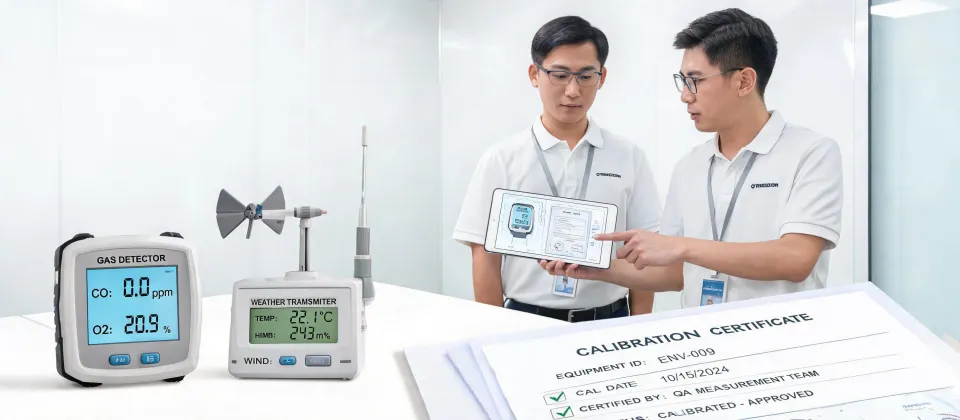
- Check if they can provide calibration certificates with proper traceability if you need them
I get why people go with whatever vendor is cheapest—budgets are real. But the hidden administrative cost of dealing with non-compliant vendors adds up. That unreliable supplier who can't provide proper documentation cost me about $400 in rejected expenses and my time sorting it out last year.
Common Mistakes to Watch For
Mistake 1: Assuming new is always better. Sometimes a refurbished instrument from an authorized center is a smarter buy—especially for budget-constrained projects. Just make sure it comes with a calibration cert and warranty.
Mistake 2: Ignoring calibration cycles. Every precision instrument needs recalibration. A multimeter that reads off by 2% isn't a bargain at any price. Factor in the annual cost of calibration (typically 10-15% of purchase price) when comparing options.
Mistake 3: Relying on "multimeter near me" or "encoder price" searches without verification. Local suppliers can be great for convenience, but their pricing isn't always competitive, and their stock on hand might not match what you actually need. Always cross-reference with the manufacturer's spec sheet.
Bottom line: Buying precision instruments as a non-specialist isn't hard—but it requires a systematic approach. Confirm the exact specs first. Only buy from authorized sources. Compare total cost. Check for hidden compatibility issues. And make sure the vendor can work with your accounting system. Follow these 5 steps, and you'll avoid the mistakes that cost time, money, and credibility.

Marcus Feld
Marcus Feld is an electrical test and measurement analyst specializing in multimeters, oscilloscopes, clamp meters, insulation testers, spectrum analyzers, and data loggers. He applies IEC 61010-2-030 and IEC 61010-031 concepts while examining measurement category, bandwidth, true-RMS response, input loading, and stated uncertainty. His work helps maintenance engineers and test teams choose safe instruments with performance suited to the signals and environments they actually measure.