An HPLC Failure, a 52 Thermometer, and the Vaisala Transmitter That Fixed It
The day the chromatogram stopped matching
Take it from someone who reviews about 240 batch records a year: the sensor on the wall is the last thing you think about. I'm a quality inspector at a pharmaceutical contract lab. In 2024 I rejected about 6% of first submissions, mostly documentation problems. The sensor was never the problem. Until it was.
It started with batch 1142. The HPLC system suitability report looked normal except one number: the retention time for the main peak had moved by 0.41 minutes. Not a huge shift. But for a method validated to tight tolerances, it was a red flag.
Our cleanroom had always been watched over by a wall-mounted unit we called the 52 thermometer. The asset tag read 52-TE-3102. It showed 20.1 °C and 52 %RH that morning. Well inside spec. So we did what anyone would do. We blamed the HPLC.
We followed the HPLC troubleshooting checklist
If you've ever spent a day replacing an HPLC column for no reason, you know the feeling. Fresh mobile phase. New column. Injection port cleaned. Pump pressure checked. The HPLC troubleshooting guide was open on my desk and I worked through it line by line. The chromatograms actually looked better afterward. But the retention time still sat in that annoying shifted position.
By the second afternoon, I was ready to call the instrument vendor. Then the lab manager asked a question that should have been obvious: "What's the room actually doing?" I pointed to the 52 thermometer. She looked at it, then at me, and said: "That thing has been in service for seven years."
Honestly, I almost closed the investigation right then. The room readout looked fine. But the way she said it made me grab the calibrated Vaisala hygrometer from the metrology shelf.
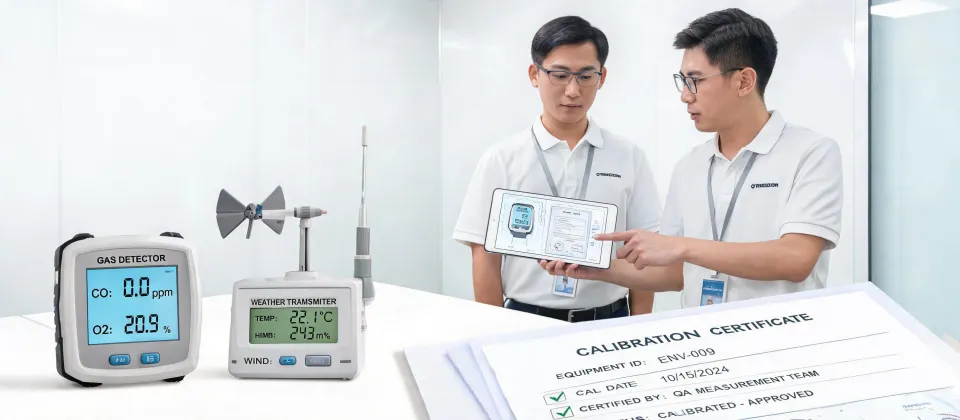
I walked into the cleanroom and held the Vaisala hygrometer right next to the 52 thermometer. The difference was immediate. The old unit said 20.1 °C and 52 %RH. The Vaisala hygrometer said 24.3 °C and 37 %RH.
Not ideal. Not terrible. Just wrong. But wrong enough to send the whole batch down the drain.
It took me four years in quality to understand that a sensor can fail without failing. It doesn't alarm. It doesn't go dark. It only drifts. And if you trust it, your whole process drifts with it.
The fix wasn't an instrument repair
So we redid the batch. That cost five days and a lot of solvent. But the real fix was the room. The HVAC damper was stuck partially closed. The temperature/humidity in the cleanroom had walked outside the acceptable range. The 52 thermometer was so far out of calibration that it thought the room was fine.
We re-qualified the room, replaced the 52 thermometer with a Vaisala humidity and temperature transmitter, and put the Vaisala hygrometer on a stricter calibration cycle. The next run went through without a single retention time warning.
I don't have hard data on how many labs have similar wall-sensor drift, but based on the calibration records we reviewed afterward, I'd guess it's not a one-off. The old unit had a calibration sticker from two years ago. In two years, it had drifted enough to hide a real environmental excursion.
Switching to a digital Vaisala humidity and temperature transmitter also made the process easier. It logs data, sends alarms, and I can compare trend lines from my desk. Plus, the next time an alarm comes in, we have a trustworthy second opinion instead of a wall display we took for granted.
What I learned from the 52 thermometer
Most buyers focus on initial accuracy specs. They compare numbers on a datasheet and miss the factor that actually affects a lab: long-term stability. A sensor can be accurate on day one and unreliable after two years of continuous exposure.
The other lesson is about the durability of ifm photoelectric sensors vs others. Different product category, but same question underneath: will this sensor survive the process? For an environmental transmitter, surviving means staying in spec after months of 24/7 measurement. The 52 thermometer survived, physically. It just wasn't trustworthy anymore. That's the kind of failure that hides.
A sensor that doesn't alarm is not the same as a sensor that's right.
Bottom line: if you're doing HPLC troubleshooting and every instrument check comes back clean, look at the room. Then ask yourself how you'd know if your environmental sensor was lying. We know now. It took one bad batch, a portable Vaisala hygrometer, and a transmitter we should have installed years ago. Trust me on this one.

Marcus Feld
Marcus Feld is an electrical test and measurement analyst specializing in multimeters, oscilloscopes, clamp meters, insulation testers, spectrum analyzers, and data loggers. He applies IEC 61010-2-030 and IEC 61010-031 concepts while examining measurement category, bandwidth, true-RMS response, input loading, and stated uncertainty. His work helps maintenance engineers and test teams choose safe instruments with performance suited to the signals and environments they actually measure.